Before the Hairdresser: The Prehistoric Origins of Hair Care
History of Hairdressing · Prehistory & Origins · Chapter 1
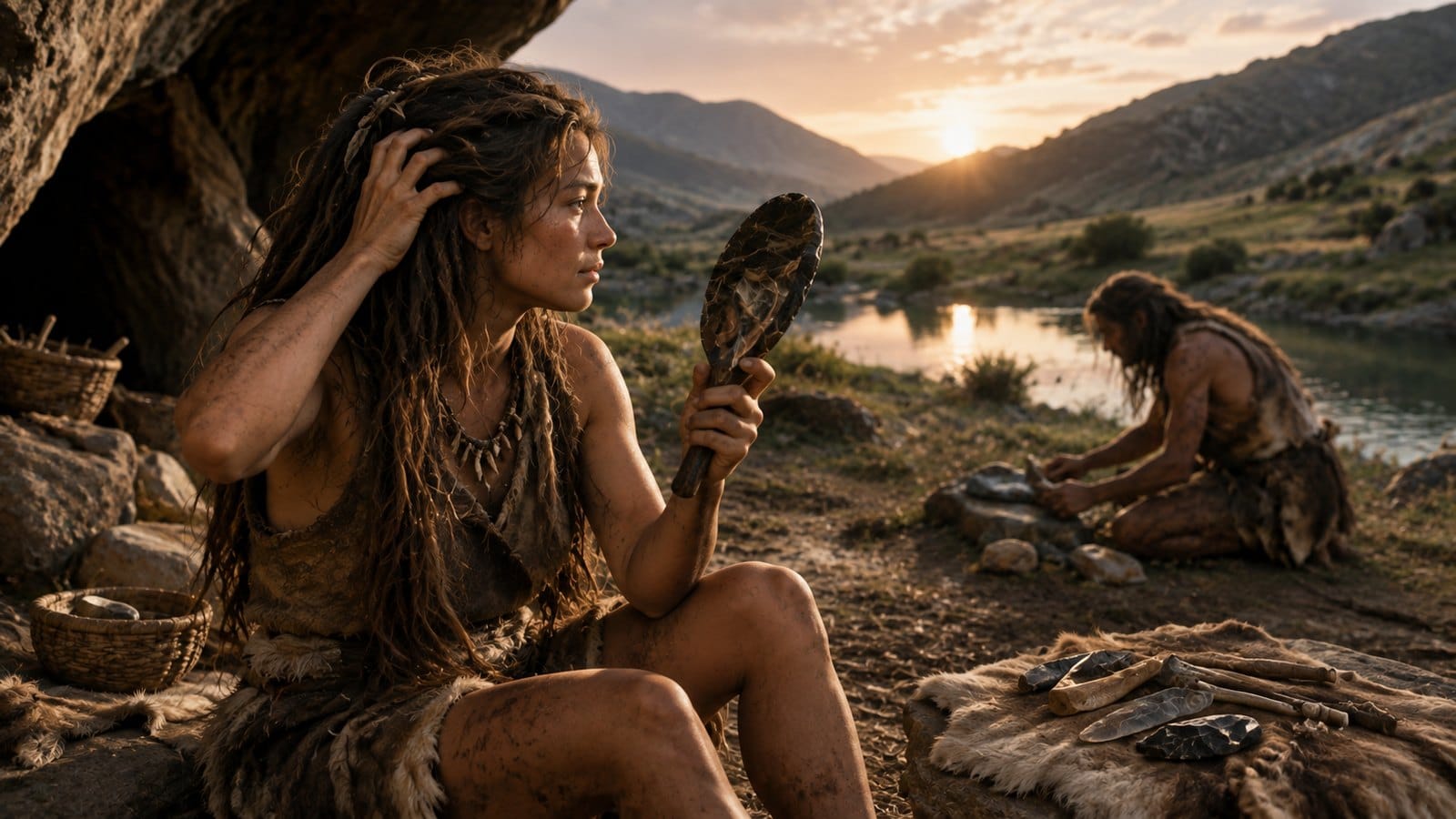
There was a time before the salon, before the barber, before scissors, combs and mirrors – but there was probably never a time when human beings were completely indifferent to their hair.
The story of prehistoric hair care begins far beyond written history, in a world where almost everything connected with grooming has disappeared. Hair rarely survives for thousands of years. Wooden implements decay. Plant fibres vanish. Daily gestures leave almost no archaeological trace. What remains are fragments: exceptional preserved hair, stone and bone artefacts, human representations, pigments, ornaments and, much later, rock art showing people with carefully arranged hair.
Those fragments do not allow us to reconstruct the world’s first hairstyle or identify the first person who cut another person’s hair. They reveal something more important: hair management belongs to a remarkably deep history of human behaviour.
Long before hairdressing became a profession, hair had already become something humans could clean, control, cut, arrange, decorate – and eventually use to communicate identity.
Hair Before Hairdressing
Modern hairdressing depends on specialised tools, products, spaces and trained professionals. None of those categories can simply be projected backwards into deep prehistory.
For the earliest periods, archaeology cannot identify a “hairdresser” in the modern sense. Nor can it tell us exactly when deliberate hair care began.
This distinction is essential.
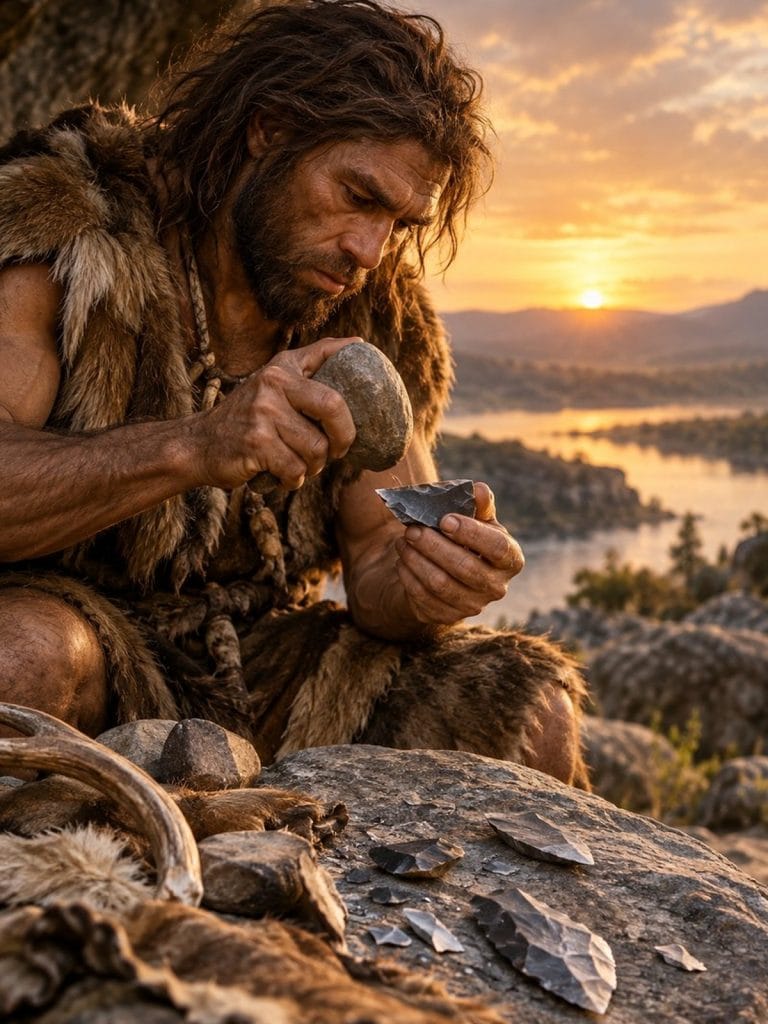
What archaeology can demonstrate is that prehistoric people possessed increasingly sophisticated technologies for working with bodies and natural materials. Cutting tools, scraping implements, pigments, fibres, ornaments and later combs all became parts of human material culture. Some could have been applied to hair, but an object capable of cutting or scraping is not automatically evidence that it was used for grooming.
The history therefore begins not with a single invention, but with a gradual transformation of the human body into something increasingly managed and culturally expressed.
Archaeologist Steven Ashby has emphasised that hair should be understood not merely as preserved biological material but through the objects used to care for it and the ways hair was represented. Such evidence provides a connection between the body, material culture and personal identity.
The Archaeological Problem: Hair Almost Disappears
Reconstructing prehistoric hair care presents an unusual challenge.
Stone survives exceptionally well. Hair does not.
Unless human remains are preserved under unusual environmental conditions, the hair itself decomposes. The same problem affects many potential grooming materials. A sharpened flint may survive for tens of thousands of years, while a wooden pin, fibre tie or other organic accessory used beside it may disappear entirely.
This creates an archaeological imbalance.
We possess enormous quantities of prehistoric stone technology, but this does not mean stone was the only material people used. Nor can every sharp implement be classified as a razor or hair-cutting tool simply because it could theoretically perform that function.
The surviving record must therefore be read cautiously. Archaeology of hair frequently depends on combining different categories of evidence: preserved remains, objects, artistic representation and archaeological context.
That is why the earliest history of hair care contains three different levels of certainty: what can be proven, what is probable, and what remains unknown.
Why Humans May Have Started Managing Their Hair
The first motivations for grooming were probably practical long before they became recognisably aesthetic.
Long scalp hair can obstruct vision, collect dirt and become tangled. Parasites provide another obvious reason for manipulating, inspecting and maintaining hair.
Direct archaeological and biological evidence shows that lice have accompanied humans for a very long time. This does not prove a specific prehistoric grooming routine, but it reinforces the practical pressures that would have made inspection and management of hair useful.
But practicality alone does not explain the later archaeological evidence.
At some point, managing hair was no longer simply about controlling something growing from the body. Hair became visible culture.
The Human Scalp Became a Unique Canvas
Human evolution created an unusual visual feature: comparatively reduced body hair combined with scalp hair capable of substantial growth.
The precise evolutionary history of long human scalp hair remains an active area of research. Prehistoric artistic representations include figures apparently displaying substantial scalp hair and elaborate arrangements, although interpretation of individual representations remains debated.
That distinction matters.
A prehistoric figure with markings around its head does not automatically prove a particular hairstyle. The markings might represent hair, a cap, woven headgear, a net or something modern observers have not correctly identified.
Yet the repeated attention given to the human head in prehistoric art is significant.
Once hair could be shortened, gathered, tied, twisted or covered, its appearance became changeable in ways that other parts of the body were not.
Hair became one of humanity’s most renewable materials for altering appearance.
A Glimpse from the Upper Palaeolithic
One of the most famous prehistoric human representations demonstrates both the potential and the danger of interpreting ancient hair.
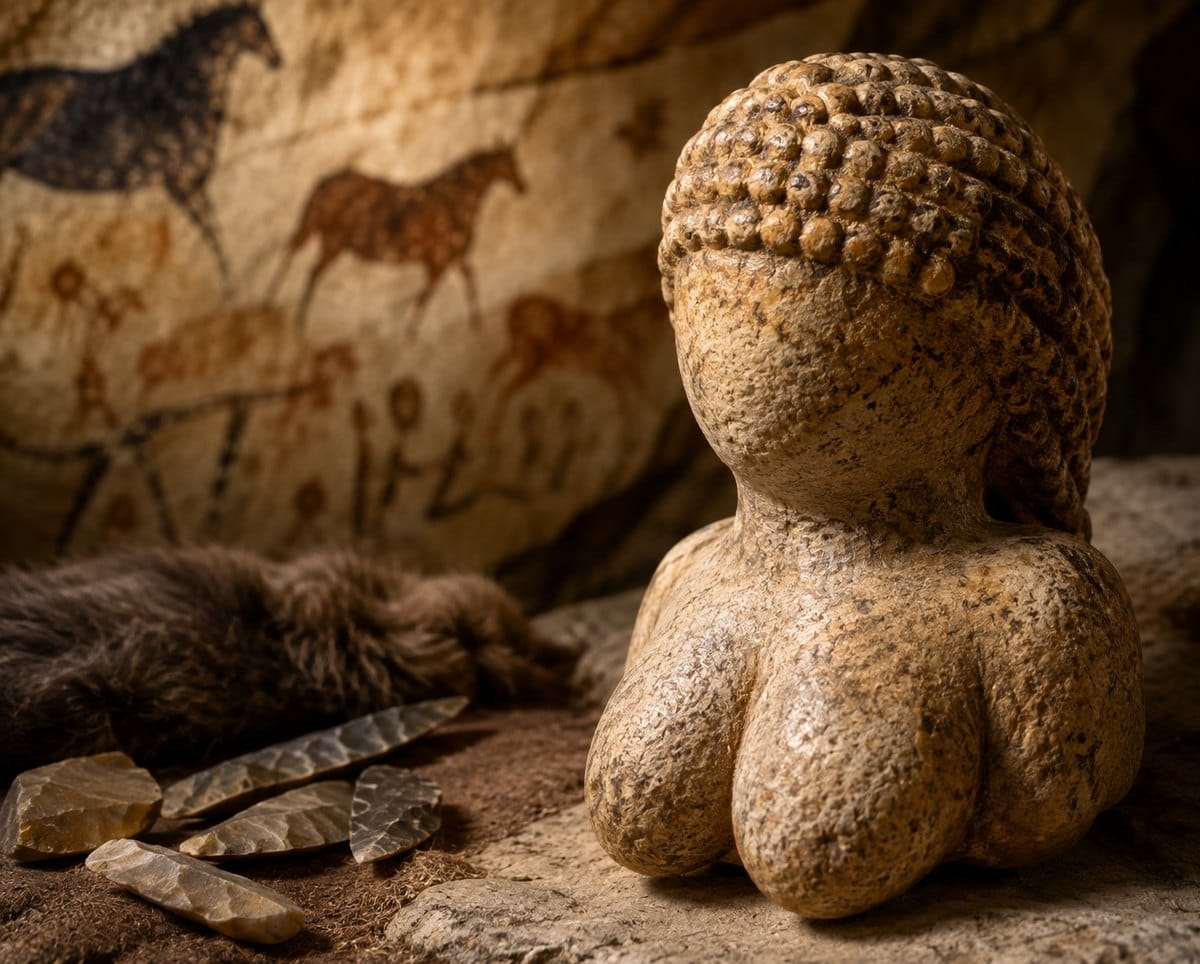
The approximately 29,500-year-old Woman of Willendorf, discovered in Austria in 1908, has an intricately worked head covered by repeated patterns. Vienna’s Natural History Museum describes this feature cautiously as an elaborate hairstyle or a basket-weave cap.
That “or” is enormously important for the history of hairdressing.
Earlier viewers could easily see carefully arranged hair. Archaeological research into Upper Palaeolithic fibre technology, however, has demonstrated that some details on prehistoric female figurines may represent sophisticated woven headgear rather than hairstyles.
So what does Willendorf prove about prehistoric hairdressing?
Not that women wore one specific braided hairstyle.
It proves that prehistoric people were capable of detailed visual treatment of the head and that modern interpretation must distinguish carefully between hair and headwear.
That uncertainty makes the evidence more scientifically valuable, not less.
From Grooming to Deliberate Appearance
There is an important conceptual distance between removing tangled hair from the face and deliberately creating a recognisable appearance.
We cannot date the moment when humanity crossed that boundary.
It almost certainly did not happen everywhere at once.
Different human groups living across different environments would have developed their own practical and cultural approaches to the body. Climate, available materials, hair characteristics, mobility, social structures and local traditions would all have influenced grooming behaviour.
What becomes increasingly visible in later prehistoric evidence is deliberate differentiation.
Hair can be altered without permanently changing the body. It grows back. It can be rearranged repeatedly. It can distinguish individuals while remaining part of the individual.
That makes hair extraordinarily powerful as a social medium.
Research into later prehistoric Europe has consequently examined hair not simply as grooming but as a potential visual language connected with selfhood, belonging and difference.
When Hair Became Social
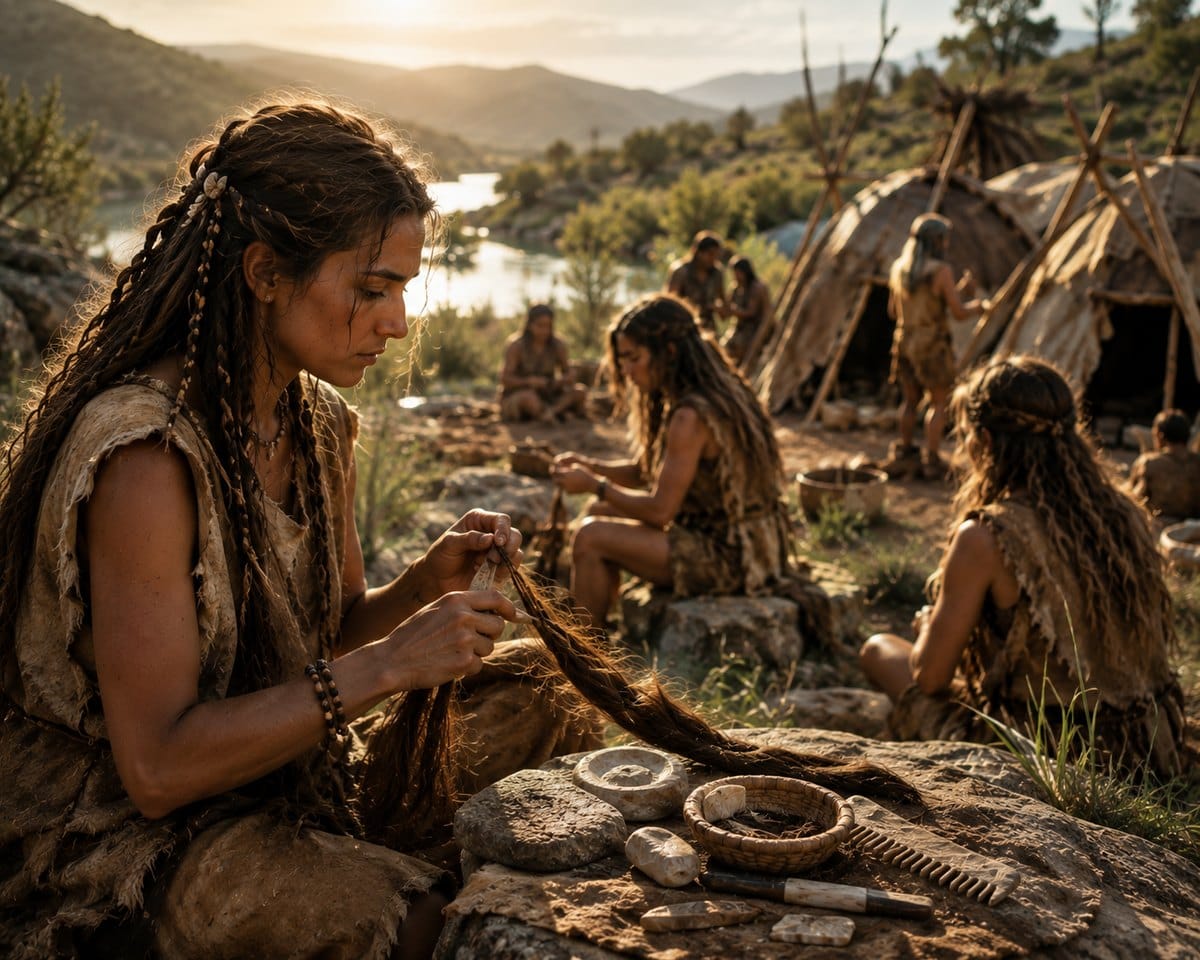
A hairstyle is never merely hair once other people can recognise its meaning.
It may communicate age, status, gender, group affiliation, ritual position or individual taste. The exact meanings of prehistoric hairstyles are usually impossible to recover because the people who understood their codes left no written explanations.
But archaeological interpretation becomes stronger when hair appears within recognisable social scenes.
An exceptional example comes from the Acacus Mountains of south-western Libya.
Rock art at Uan Amil depicts figures with elaborate coiffures and scenes interpreted as people attending to or preparing another person’s hair. The British Museum’s African Rock Art project describes one remarkable image in which a figure with an ornate hairstyle appears to wash or attend to another person’s hair.
Here we move closer to something recognisably connected with hairdressing.
Not yet a salon.
Not yet proof of a professional occupation.
But unmistakably a social interaction involving hair.
The Acacus Evidence: A Human Moment Across Millennia
The Uan Amil scenes are particularly compelling because hair preparation appears within broader communal activity.
The rock shelter was occupied through several phases between approximately the eighth and fourth millennia before present. Dating the paintings themselves is more difficult, and scholarly caution is necessary.
What is visible, however, is extraordinary.
One human appears to attend to another’s head. Elsewhere figures display conspicuous coiffures. Hair preparation is represented not as an isolated mechanical action but as part of social life.
The images suggest that by this later stage of prehistory, in at least some communities, hair could demand time, skill and interpersonal attention.
That does not prove the existence of professional hairdressers.
It does reveal something fundamental that still defines hairdressing today: one person entrusting their appearance to the hands of another.
Hair, Touch and Human Relationships
Hair care is unusual because much of it is difficult to perform alone.
Someone else can see the back of the head more easily. Another pair of hands can divide, bind, arrange or inspect hair with greater precision.
That simple physical reality may have helped make grooming a social activity.
The Acacus scene provides unusually evocative evidence of this interpersonal dimension, although we cannot know the exact relationship between the figures depicted.
Were they relatives? Friends? Members of the same social group? Was one particularly skilled?
Archaeology cannot answer those questions.
And this is precisely where we must resist turning a beautiful image into an invented story.
What we can say is that hair care had the potential to create repeated interactions involving trust, touch, skill and observation. Those interactions would eventually become central characteristics of professional hairdressing.
Hair as Identity Before Written History
By later prehistory, evidence from artistic representation, preserved hair and grooming equipment allows archaeologists to ask questions far beyond hygiene.
Miranda Aldhouse-Green’s study of hair in later prehistoric Europe considers hair as part of the presentation of self, belonging and difference, while also warning that meanings must be reconstructed from incomplete evidence.
This gives us a crucial principle for the entire history of hairdressing:
Hair becomes historically important when changing it changes how a person is seen.
Once communities recognise different ways of presenting hair, grooming can become communication.
Long or short. Controlled or loose. Covered or exposed. Decorated or undecorated. Carefully arranged or intentionally neglected.
We should not assign specific prehistoric meanings to these contrasts without evidence. But the capacity of hair to carry social information is deeply rooted in human culture.
Hair care was moving beyond maintenance.
It was becoming appearance.
The First Tools Remain a Separate Story
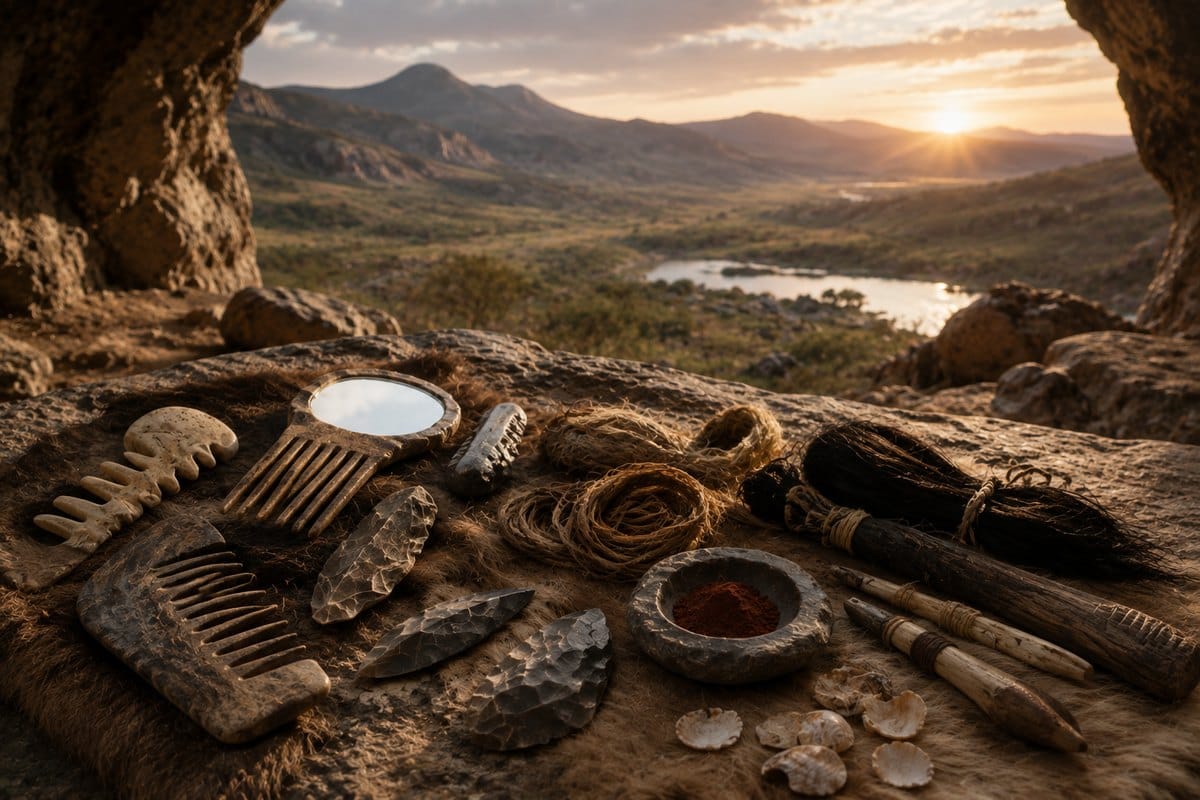
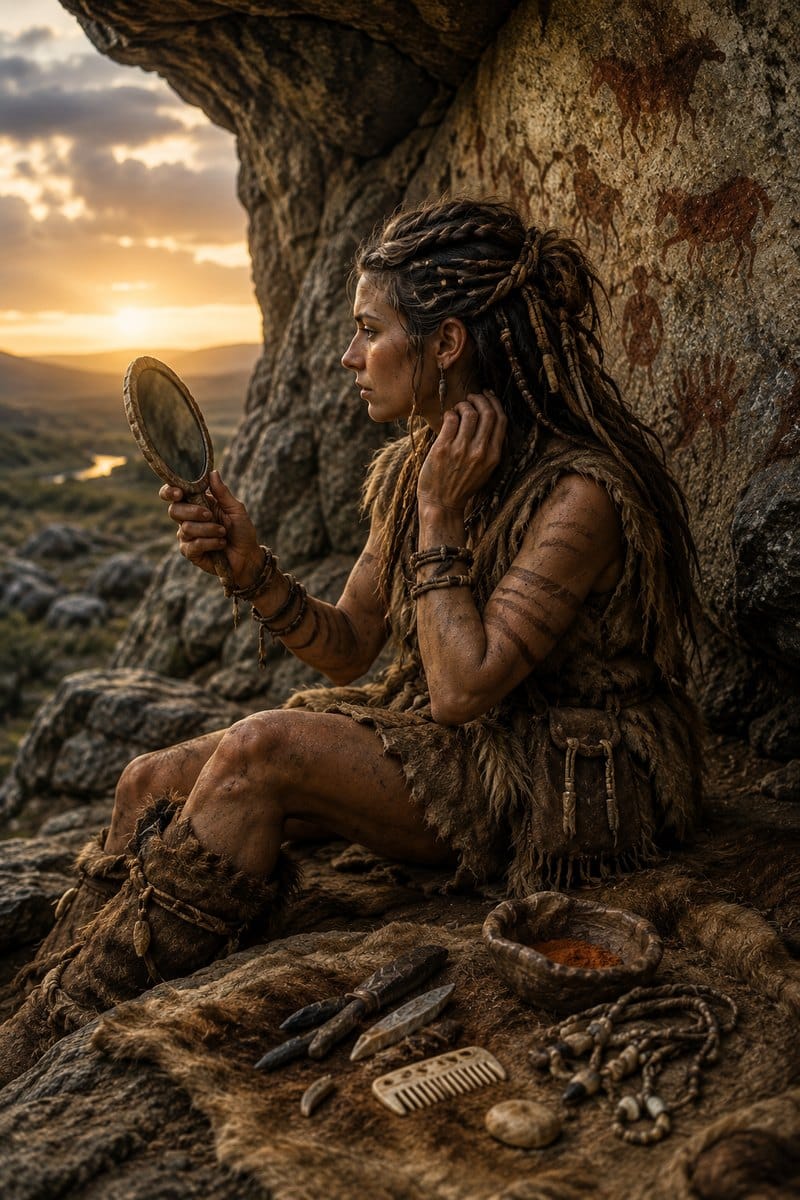
It is tempting to imagine a prehistoric grooming kit: sharpened flint for cutting, shell for scraping, bone pins, fibres for tying and pigments for colouring.
Some of these possibilities are plausible.
But plausibility is not proof.
A stone blade used to butcher an animal could also cut hair, but without contextual or microscopic evidence we cannot automatically call it a hairdressing tool. A pointed bone object could potentially secure hair, but it might have served an entirely different purpose.
For that reason, the origins of hair care should not be constructed by simply relabelling ordinary prehistoric artefacts as salon equipment.
Later archaeological periods provide much firmer evidence for dedicated grooming objects. Predynastic Egypt, for example, produced elaborately carved ivory hair combs. The Metropolitan Museum of Art dates one ceremonial example to approximately 3200–3100 BCE, at the end of Egyptian prehistory.
The emergence of specialised tools is important enough to deserve its own chapters.
Our next steps will therefore examine separately how prehistoric people may have cut hair, what early tools could actually have been used for grooming, and how the comb eventually became one of humanity’s most recognisable hair-care objects.
Why It Matters to Hairdressing History
The history of hairdressing does not begin with a salon.
It does not begin with metal scissors, a written beauty manual or the first named barber.
It begins with a much older human decision: hair did not simply have to be left as nature produced it.
Humans could intervene.
They could manage it for practical reasons. They could touch and arrange another person’s hair. They could transform the appearance of the head. Eventually, hairstyles could participate in social identity and visual culture.
The archaeological evidence is fragmentary, and much remains unknown. That uncertainty must remain visible rather than being filled with romantic reconstructions of imaginary Stone Age hairdressers.
But the surviving evidence is enough to reveal a remarkable continuity.
Thousands of years before the profession had a name, the essential human impulses behind hairdressing were already emerging: grooming, transformation, skill, appearance, communication and the intimate act of one person caring for another person’s hair.
Professional hairdressing would come much later.
The human fascination with hair came first.
Next in the History of Hairdressing: The First Haircut: How Prehistoric Humans Cut Their Hair
The next chapter investigates a deceptively simple question: how did prehistoric people actually cut their hair before scissors existed? It will separate what early stone technology made possible from what archaeology can genuinely prove about humanity’s first haircuts.