The First Haircut: How Prehistoric Humans Cut Their Hair
History of Hairdressing · Prehistory & Origins · Chapter 2
Imagine wanting shorter hair in a world without scissors.
There is no steel blade, no razor, no barber’s chair and no written instruction explaining how the task should be done. Yet prehistoric humans possessed something essential: the ability to manufacture extraordinarily sharp cutting edges from stone.
This makes the prehistoric haircut one of the most intriguing problems in the early history of hairdressing.
Could a flint blade cut human hair? Certainly. Could obsidian produce an edge fine enough for shaving? Absolutely. Does that mean every sharp prehistoric blade was a grooming tool? No.
That distinction defines this chapter.
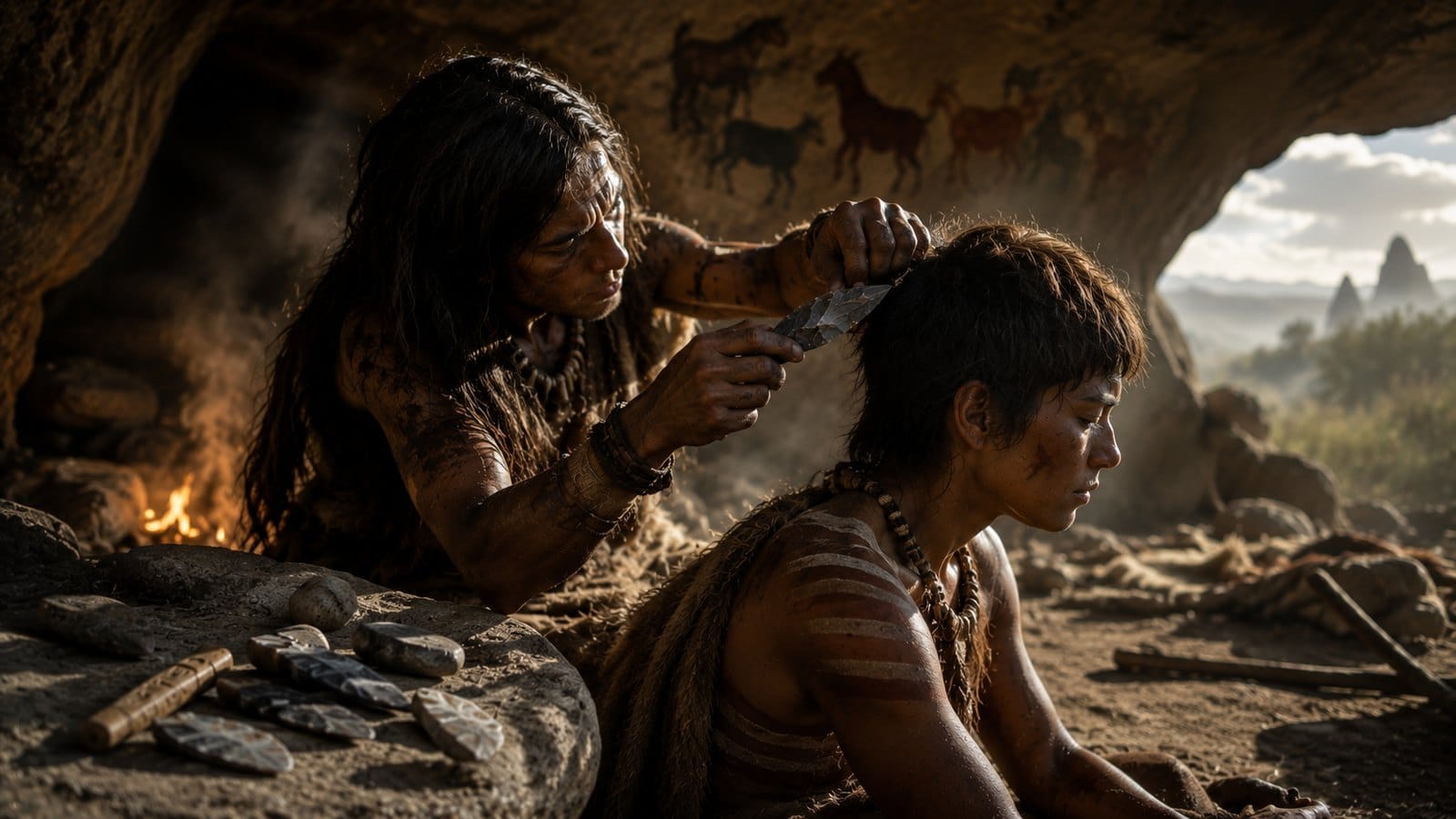
Archaeology gives us abundant evidence for prehistoric cutting technology, later artistic evidence for deliberately altered hairstyles, and ethnographic examples showing that stone and glass edges can be used successfully for cutting and shaving hair. What it rarely gives us is the moment itself: a prehistoric person sitting while another person cuts their hair.
The first haircut has disappeared.
But the technology that made it possible has not.
Before Scissors, There Was the Cutting Edge
Scissors are a relatively late development in the enormous timeline of human technology.
For most of prehistory, people who wanted to separate one material from another relied on edges produced from stone, bone and other available materials.
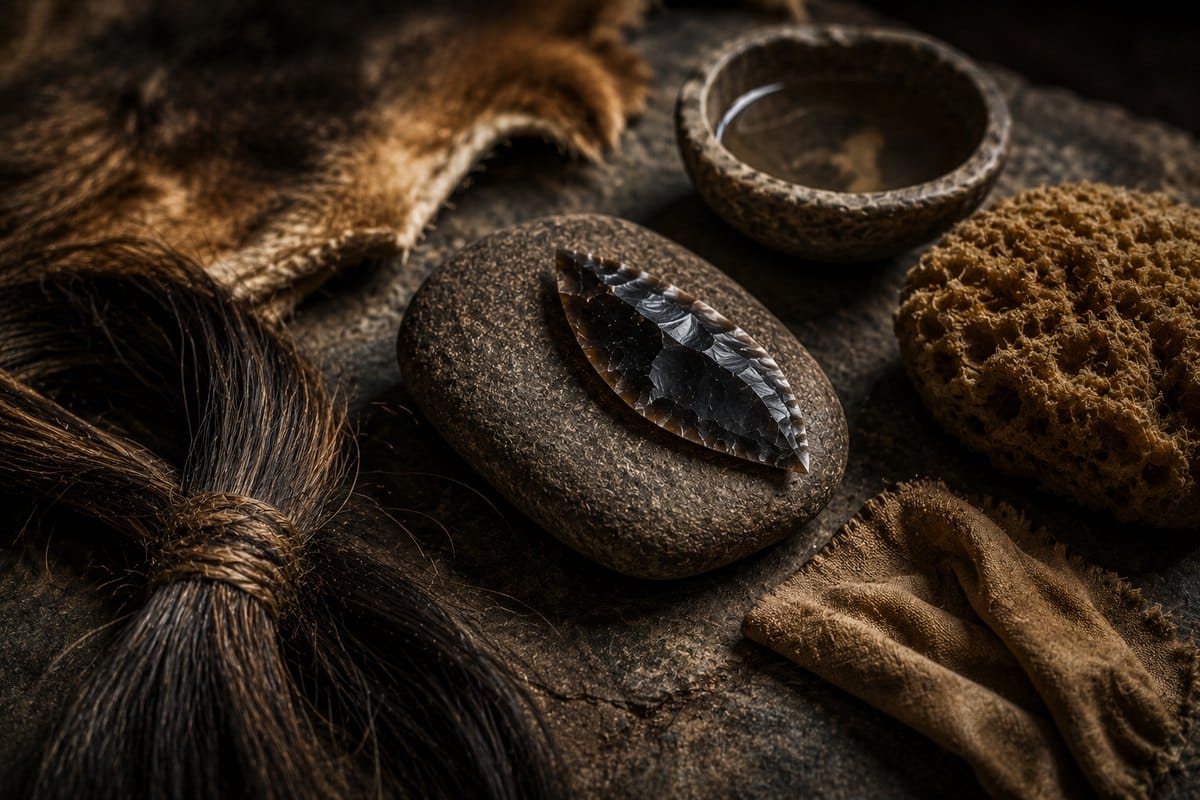
Among the most important was flint.
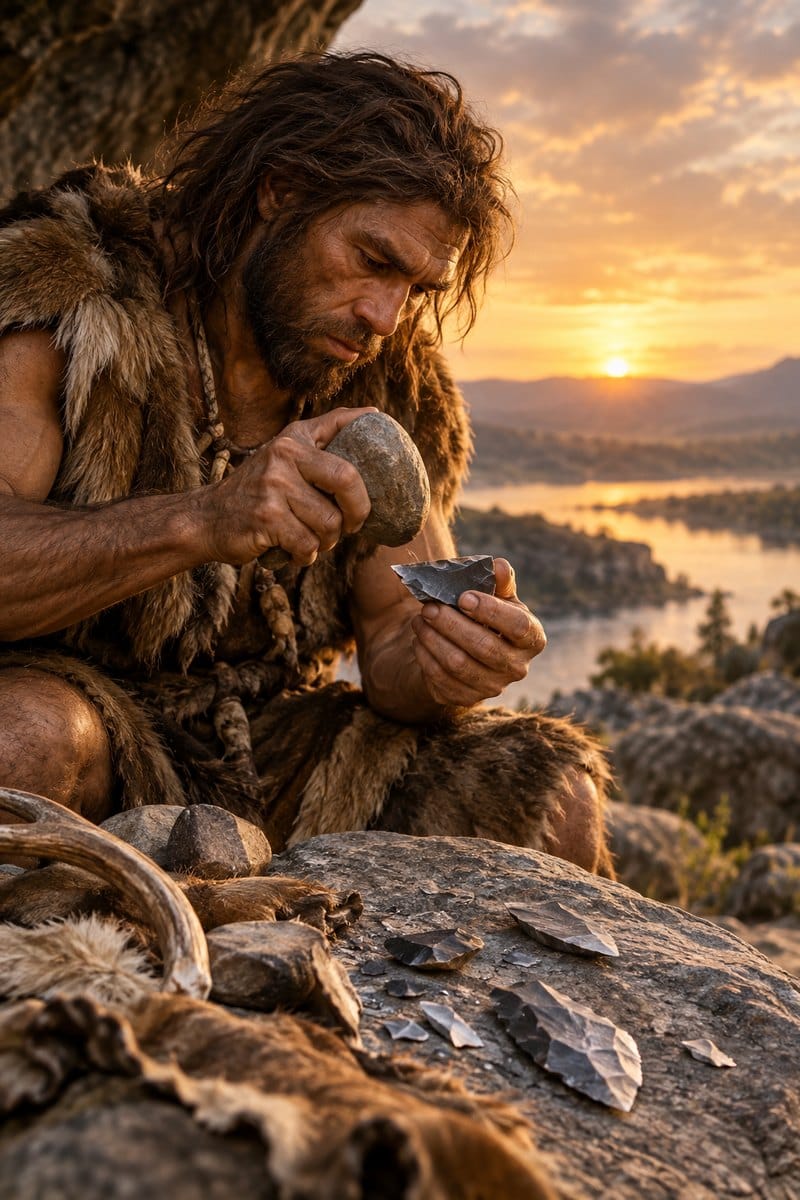
When fractured correctly, fine-grained stone can produce extremely sharp edges. Prehistoric communities became highly skilled at controlling this process, manufacturing blades and flakes suited to different tasks.
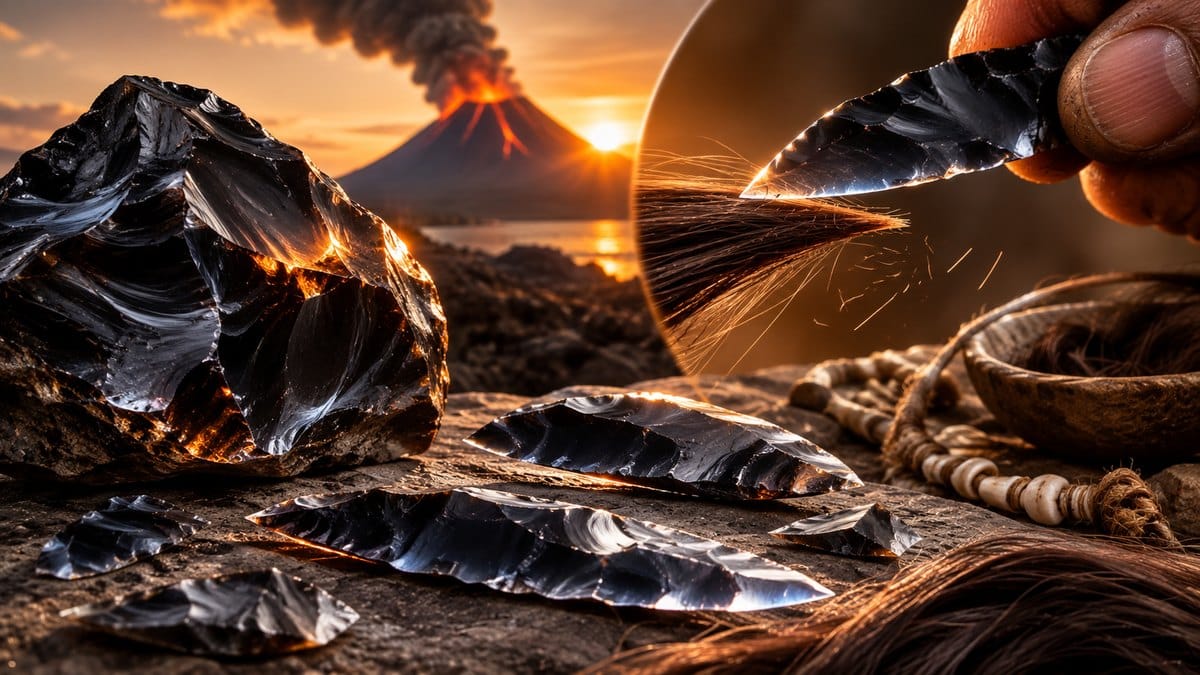
Obsidian – naturally occurring volcanic glass – can produce an even finer edge.
These technologies existed primarily because prehistoric people needed to cut meat, hides, fibres, plants and other materials essential to survival. Archaeological use-wear studies can sometimes identify traces associated with particular activities.
Hair presents a much harder problem.
It leaves little archaeological evidence on a stone edge after thousands of years, and an implement capable of cutting hair might have been created for an entirely different purpose.
So the existence of a sharp blade proves technological capability.
It does not automatically prove a haircut.
Could Flint Actually Cut Human Hair?
Yes.
From a mechanical perspective, a sufficiently sharp flint edge can cut hair.
This should not be surprising. The fracture properties of suitable stone allow prehistoric knappers to produce thin, keen cutting edges capable of working soft organic materials.
Experimental archaeology has demonstrated how effectively prehistoric lithic technologies could perform specialised cutting tasks. Use-wear analysis can sometimes distinguish the materials worked by ancient tools, although interpretation depends heavily on preservation and archaeological context.
But there is an important difference between saying:
“prehistoric humans possessed tools capable of cutting hair”
and saying:
“this prehistoric blade was used to cut hair.”
The first statement is well supported.
The second requires specific evidence.
A blade discovered at a prehistoric site may have been used for animal processing, hide working, plant cutting, craft production or many other activities.
Without microscopic wear, residues or compelling contextual evidence, calling it a hair-cutting blade would be speculation.
This is one of the central archaeological limits surrounding the first haircut.
Obsidian: Nature’s Extraordinary Blade
If flint made prehistoric hair cutting technically possible, obsidian makes the possibility even easier to imagine.
Obsidian forms when volcanic lava cools rapidly with minimal crystal growth. When fractured, it can produce exceptionally fine edges.
Its cutting properties have made obsidian valuable to human communities in volcanic regions for thousands of years.
More importantly for our story, historical and ethnographic evidence demonstrates that people have genuinely used obsidian flakes for shaving and cutting hair.
Research discussing Later Stone Age technological miniaturisation records ethnographic observations from several regions where obsidian or freshly fractured glass was used as a razor. Examples include hair cutting and shaving in parts of New Guinea and shaving with obsidian flakes in Ethiopia.
These examples are not direct evidence for Palaeolithic haircuts.
They demonstrate something different but extremely useful.
A simple sharp flake can function effectively as a grooming blade.
The technology does not require metal.
That strengthens the probability that prehistoric people who wished to remove or shorten hair possessed the means to do so.
Cutting Hair Was Probably Not Like Using Scissors
Modern scissors create a particular cutting action: two blades move against each other while hair is held between them.
A stone blade works differently.
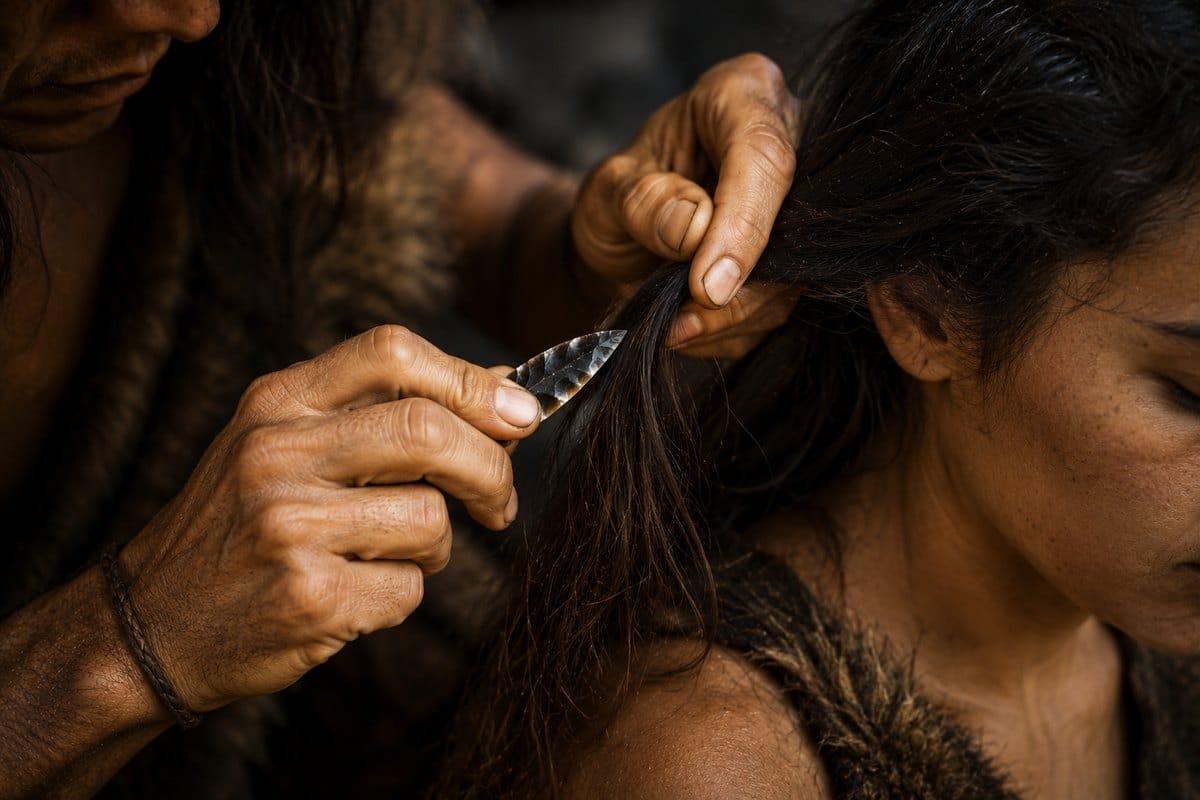
If prehistoric people used sharp flakes to shorten hair, the technique probably resembled slicing rather than modern scissor cutting.
Hair could potentially be gathered into small sections, held under tension and cut against a supporting surface or carefully sliced with a sharp edge.
There is an illuminating later ethnographic object in the Smithsonian Institution’s collections from the Aleutian Islands: a thin piece of bone identified as having been used beneath strands of hair while a sharp knife was pressed against them. The bone effectively acted as a cutting board.
This object is not prehistoric evidence for humanity’s first haircut.
Its importance lies in demonstrating a practical solution to the mechanical problem.
Hair can be held against a resistant surface and separated with a sharp blade.
Prehistoric communities could have developed comparable techniques independently using materials available to them.
Whether they actually did so in deep prehistory remains unknown.
Cutting, Sawing, Singeing – What Do We Really Know?
Once we imagine people without scissors, many possible methods appear.
Sharp stone is the most obvious.
Other techniques have sometimes been proposed in popular accounts: abrasion, pulling, breaking, cutting against a surface or even singeing hair with fire.
The problem is evidence.
The fact that a technique is physically possible does not mean archaeology has demonstrated its prehistoric use.
Fire, for example, was certainly available to prehistoric humans. Hair can obviously be burned. But turning those two facts into a claim that prehistoric people routinely styled their hair by singeing it would go beyond the evidence.
The same caution applies to shells, bone edges and other materials.
Some may have been capable of cutting, scraping or assisting hair management.
Capability is not use.
For the earliest history of hairdressing, the responsible conclusion is therefore narrower but stronger: sharp lithic technology gave prehistoric humans an effective means of shortening or removing hair, while the exact techniques used remain largely undocumented.

Did Prehistoric People Shave?
Here the distinction between cutting and shaving becomes important.
A haircut shortens hair.
Shaving removes it close to the skin.
Could a fine stone or obsidian edge shave human hair?
Yes. Later documented use demonstrates that it can.
Can we prove routine shaving deep in the Stone Age?
Much more cautiously.
Some prehistoric artistic representations appear to show deliberately controlled hairlines or areas of the scalp without hair. But representations are difficult to interpret. A smooth head may indicate shaving, natural hair loss, artistic convention, headwear or simply the limitations of the medium.
Such material is fascinating evidence for deliberate representations of hair.
It should not be transformed into certainty about the exact cutting instrument or grooming procedure.
A hairstyle can survive in art while the tool that produced it remains unknown.
The Person Behind the Blade
There is another question hidden inside the first haircut:
Who performed it?
Some hair can be cut by the person wearing it. Other parts of the head are far more difficult to see and control without a mirror.
This creates a compelling possibility.
Hair cutting may have been interpersonal very early in human history.
One person could hold sections of another person’s hair, maintain tension and control the cutting edge more safely and accurately.
We cannot identify the first individual who developed this skill.
We cannot call that person a professional hairdresser.
But repeated grooming inside a family or community could naturally create differences in ability. Someone with steady hands, experience and knowledge of cutting edges might become the person others trusted.
That is not proof of a prehistoric profession.
It is a plausible pathway toward specialisation.
The distance between “someone who cuts hair” and “a hairdresser” may have required thousands of years of social development.
Yet the first depended on a very simple relationship: one human allowing another human to alter their appearance.
What Prehistoric Hairstyles Tell Us About Cutting
Direct evidence for hair cutting is rare, but prehistoric representations can provide indirect clues.
If a figure appears with hair maintained at a particular length, a sharply defined hairline, a partially bare scalp or a deliberately structured arrangement, some form of grooming may have been necessary to produce that appearance.
This does not reveal the tool.
But it changes the question.
Instead of asking only whether prehistoric people could cut hair, we can ask whether surviving representations suggest that some communities deliberately controlled hair length and shape.
In later prehistory, the answer increasingly appears to be yes.
Hair was not always simply allowed to grow without intervention.
It could be managed as part of appearance.
And once length itself becomes deliberate, cutting becomes part of the story.
A Warning from Ötzi
Few prehistoric individuals are more famous than Ötzi, the Iceman, who lived more than 5,000 years ago.
His extraordinary preservation initially seemed to offer unusually intimate information about prehistoric appearance.
Older reconstructions frequently depicted him with substantial dark hair.
But modern research provides a valuable warning about reconstructing prehistoric hairstyles too confidently.
More recent genetic research by the Max Planck Institute for Evolutionary Anthropology and Eurac Research concluded that Ötzi had a genetic predisposition to advanced male-pattern baldness and may have been largely bald when he died.
This does not tell us how Ötzi cut his hair.
It teaches us something equally important.
Even with one of the world’s best-preserved prehistoric humans, reconstructing hair appearance can be surprisingly difficult.
For individuals tens of thousands of years older, certainty becomes even more elusive.
The Difference Between Possible, Probable and Proven
The first haircut is an ideal example of why prehistoric hair history requires disciplined language.
PROVEN: Prehistoric humans manufactured extremely sharp stone cutting tools.
PROVEN: Obsidian and other sharp flakes are physically capable of cutting and shaving human hair.
PROVEN: Later documented societies used obsidian, glass and other sharp non-metal edges for hair cutting or shaving.
PROVEN: Prehistoric artistic representations sometimes show apparently deliberate variations in hair length and arrangement.
PROBABLE: Some prehistoric humans used sharp stone edges to shorten or remove hair.
PROBABLE: Hair cutting sometimes involved assistance from another person.
UNKNOWN: When the first intentional haircut occurred.
UNKNOWN: Who performed it.
UNKNOWN: Which exact technique was first used.
UNKNOWN: Whether the earliest hair cutters had any recognised specialised social role.
This may seem less dramatic than claiming archaeologists have discovered “the world’s first razor.”
But it is far more interesting.
It shows us how a profession can have roots much older than the evidence for the profession itself.
From Cutting Technology to Hairdressing Skill
A tool alone does not create hairdressing.
Skill does.
Anyone who has watched a professional haircut understands that the result depends not simply on the sharpness of the instrument but on control: where hair is held, how tension is applied, which sections are removed and how one cut relates to another.
We cannot know how sophisticated prehistoric hair cutting became.
But the moment people began deliberately controlling length rather than merely removing inconvenient hair, technique mattered.
A poorly controlled stone edge could produce an uneven result or injure the skin.
An experienced hand could presumably work more carefully.
Repetition creates knowledge.
Knowledge can create skill.
Skill can acquire social value.
This is the deeper significance of the prehistoric haircut. It represents one of the earliest possible points at which technology, the human body and deliberate appearance began to intersect.
The blade may have been made for many purposes.
The decision to use it on hair transformed it into something else.
Why It Matters to Hairdressing History
The first haircut cannot be dated.
No archaeologist can point to one stone blade and confidently declare: this is where hairdressing began.
Yet the absence of that single object does not leave us without a history.
Prehistoric humans possessed cutting technologies capable of altering hair. Later ethnographic evidence confirms that extremely simple stone and glass edges can function as effective razors and hair-cutting implements. Prehistoric representations increasingly reveal hair as something deliberately arranged, controlled and visually meaningful.
Together, these strands of evidence make intentional prehistoric hair cutting highly plausible.
And that matters because cutting changes the relationship between humans and hair.
Hair is no longer simply cleaned, moved away from the face or tied back.
Its length itself becomes controllable.
Once humans discovered that they could choose where hair ended, they gained an entirely new way to shape appearance.
That decision lies at the foundation of every haircut that followed – from the first uncertain stroke of a stone edge to the precision techniques of the modern salon.
We may never know who gave the first haircut.
But somewhere in prehistory, someone looked at another person’s growing hair, took a sharp edge in hand and deliberately changed its shape.
Hairdressing had not yet become a profession.
One of its defining acts had already begun.
Next in the History of Hairdressing: The First Hair Tools: Stone, Flint, Shell and Bone
The next chapter moves from the action to the objects themselves. We will examine stone, flint, shell and bone to determine which prehistoric materials genuinely could have participated in hair care – and, just as importantly, which objects should not be labelled hairdressing tools without archaeological evidence.