
The Origins of Shaving: Before the Metal Razor
History of Hairdressing · Prehistory & Origins · Chapter 5
Shaving seems inseparable from the razor. Today, the relationship is so obvious that it is difficult to imagine one without the other. Yet humans possessed the ability to cut and remove hair thousands of years before metalworkers began producing specialised bronze or copper shaving tools.
The origins of shaving therefore belong to a much older story.
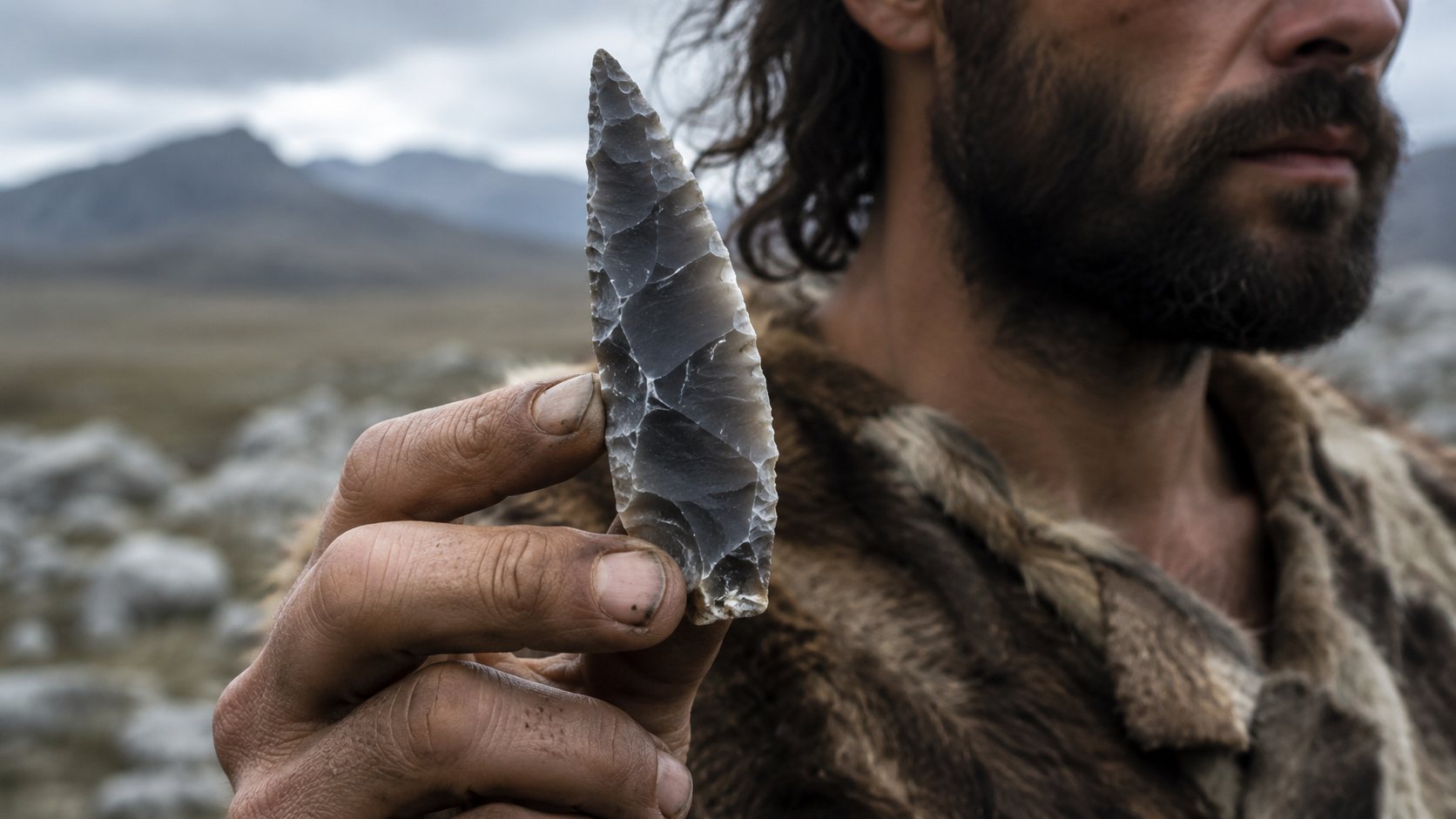
Prehistoric people were skilled manufacturers of stone tools. Flint and other suitable stones could be fractured to create extremely sharp edges capable of cutting animal tissue, hides, plant fibres – and human hair. This technological possibility has encouraged a familiar image of prehistoric people shaving themselves with pieces of sharpened stone.
The reality is more complicated.
An edge capable of cutting hair is not automatically a razor. Archaeologists may recover thousands of sharp stone flakes from a prehistoric site, but proving that a particular one was used specifically for shaving can be extremely difficult.
The history of shaving before metal is consequently a story built from evidence, experimentation and uncertainty. It shows us what prehistoric technology made possible while reminding us how carefully possibility must be separated from archaeological proof.
Hair Removal Before the Razor
Humans did not need a purpose-made razor to remove hair.
Hair can be cut, shortened, pulled, scraped or severed using a variety of materials and techniques. The development of stone cutting technology therefore gave prehistoric communities access to edges that could potentially perform some of these tasks long before metallurgy existed.
This does not tell us when shaving began.
Nor does it reveal whether the earliest intentional hair removal involved facial hair, the scalp or other parts of the body.
What it does establish is an important technological foundation. Once humans could reliably manufacture extremely sharp edges, deliberately cutting hair close to the skin became physically possible.
The conceptual distinction matters.
The origins of shaving may be much older than the origins of the specialised razor.
The first person to remove hair intentionally may simply have adapted an existing cutting technology to the human body rather than inventing an entirely new class of tool.
If so, shaving began as a technique before it became associated with a dedicated object.

The Extraordinary Sharpness of Stone
Stone Age technology is sometimes imagined as crude. In reality, skilled stone knapping could produce cutting edges of remarkable quality.
Flint was particularly valuable because of the way it fractures. A controlled blow can detach a thin flake with an extremely sharp edge. Similar principles apply to other knappable stones, while volcanic glass such as obsidian can form exceptionally fine edges.
For prehistoric communities, these materials were fundamental technologies.
They could be used for butchery, hide processing, woodworking, plant preparation and numerous other activities. Their versatility is precisely what creates a problem when discussing shaving.
A sharp flake capable of cutting hair might have been used for many completely different purposes.
Its sharpness demonstrates capability, not function.
This is why statements that identify ordinary prehistoric flakes as “razors” must be treated cautiously unless additional archaeological evidence supports that interpretation.
Nevertheless, the existence of such cutting technology means that humans did not have to wait for bronze or iron before experimenting with deliberate hair removal.
Could Flint Really Shave Human Hair?
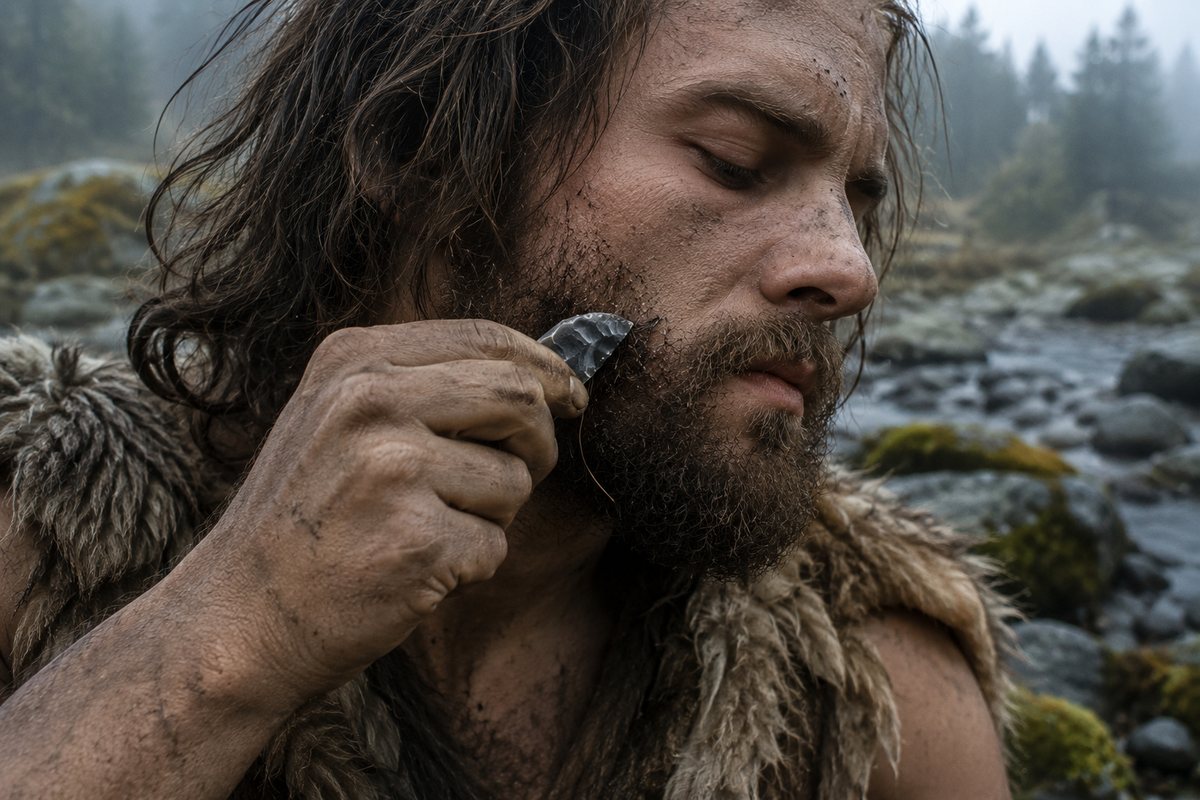
From a technological perspective, a sufficiently sharp flint edge can cut hair.
That does not mean the experience would have resembled shaving with a modern razor.
A stone flake may have an irregular shape. Its usable cutting edge may be short, and controlling the angle against skin requires care. A freshly produced edge can also be extremely sharp while other parts of the same object remain awkward to hold.
Prehistoric users, however, understood stone tools far better than modern people casually handling archaeological replicas might imagine. Knapping traditions were based on accumulated practical knowledge of fracture, edge selection and tool control.
It is therefore reasonable to consider shaving or close hair cutting technologically possible.
But possibility must remain possibility unless direct evidence is available.
Experiments demonstrating that a replica flint blade can remove hair do not prove that a particular prehistoric population used the same technique.
They show that the proposed action could work.
For our history of hairdressing, that distinction is essential.
The Problem With the “First Razor”
Finding the world’s first razor sounds like a straightforward archaeological challenge.
It is not.
If archaeologists discover a metal object with a recognisable blade form in a later historical context, comparison with similar objects can sometimes support a confident identification as a razor.
Deep prehistory is much more difficult.
A simple stone flake does not announce its purpose. Its shape may have been created intentionally, produced as a by-product of knapping or selected opportunistically because its edge happened to be useful.
Even deliberate retouch does not automatically identify the material it was intended to cut.
Archaeologists therefore examine context, microscopic wear, residues, manufacturing technique and comparisons with other finds when trying to reconstruct use.
For many potential prehistoric shaving tools, the answer remains uncertain.
There is consequently no securely identified individual who invented shaving and no universally accepted stone object that can be presented as the moment the razor was born.
The earliest history of shaving has no single starting artefact.
Cutting, Scraping or Plucking?
Shaving is only one way humans can deliberately remove hair.
This complicates the story further.
A sharp edge could cut hair close to the skin. Other tools might scrape or shorten it. Hair could also be pulled out manually or potentially removed with simple gripping implements.
Which method came first is unknown.
Even the word “shaving” can become misleading if it encourages us to imagine a modern action performed with a prehistoric substitute for a modern razor.
Early hair removal may have involved techniques that looked quite different.
People were working with the materials available to them and adapting broader technologies to grooming needs.
This wider perspective is useful because the history of hairdressing is not simply the history of familiar modern tools appearing one after another.
It is the history of humans discovering ways to alter hair.
The specialised razor represents one later solution to a much older problem.
Why Would Prehistoric Humans Remove Hair?
The motive behind early shaving is even harder to establish than the technology.
Modern explanations often sound convincing: hygiene, parasites, heat, comfort, hunting, warfare, ritual, identity or attraction.
Any of these might have mattered in particular societies.
The problem is evidence.
Prehistoric communities existed across enormous spans of geography and time. There is no reason to assume that every community treated hair in the same way or removed it for the same purpose.
Practical motives may have existed. Hair can trap dirt and parasites, and shortening it can make certain activities easier.
But appearance may also have mattered.
Once humans deliberately alter the natural growth of hair, the body itself becomes a surface that can be visually changed.
A shaved area, shortened beard or modified hairline can produce an immediately visible difference.
Without stronger evidence we cannot assign specific meanings to prehistoric shaving practices. What we can recognise is the potential for hair removal to operate simultaneously as grooming and visual transformation.

What Archaeology Can – and Cannot – Tell Us
Prehistoric shaving demonstrates one of the central difficulties of reconstructing the history of hairdressing.
Hair itself rarely survives.
Tools survive more frequently, but multifunctional tools can be difficult to interpret. Written explanations do not exist for prehistoric societies, and images showing grooming practices are scarce or ambiguous.
This leaves archaeologists working with incomplete evidence.
Microscopic use-wear analysis can sometimes identify patterns created when a tool repeatedly contacts particular materials. Residue analysis can provide additional clues. Context may also be important: an object found with personal grooming equipment can invite a different interpretation from the same object recovered from a workshop.
Yet certainty has limits.
This is why responsible history should distinguish four different levels of interpretation.
Some evidence is proven. Other conclusions are strongly probable. Some practices are merely possible. And many questions remain unknown.
The temptation to fill those gaps with an attractive story is understandable.
But uncertainty is itself part of the history.
From Multipurpose Blade to Specialised Grooming Tool
One of the most important developments in shaving history occurred when hair removal began to acquire tools recognisable as specialised grooming instruments.
A general cutting flake can perform many jobs.
A purpose-made razor represents something different.
Its form reflects an anticipated action. The maker is no longer simply producing a sharp edge that could be used for grooming; the object is increasingly designed around grooming itself.
This transition cannot be reduced to a single date everywhere in the world.
Different technological traditions developed at different times, and archaeological terminology is not always uniform.
Nevertheless, the appearance of specialised metal razors marks a major change in the quality of the evidence.
Instead of asking whether an ordinary cutting tool might have touched human hair, archaeologists begin encountering objects whose form and context support a much more specific interpretation.
The razor had begun to emerge as a category of personal tool.
When Metal Changed Shaving
Metallurgy transformed many cutting technologies, including grooming equipment.
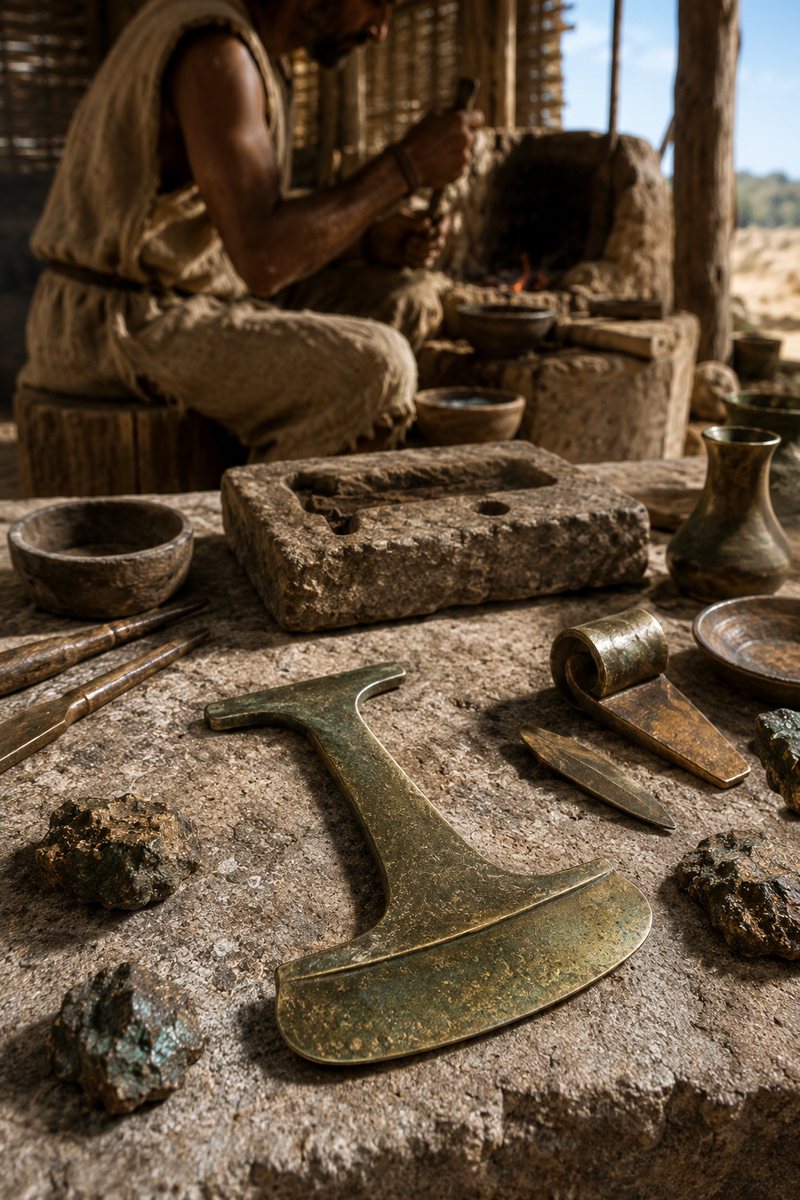
Copper and bronze could be shaped into controlled forms and resharpened. Unlike an expedient stone flake, a metal razor could be manufactured as a durable personal object with a deliberately designed blade and grip.
By the Bronze Age, archaeological collections contain objects identified as razors or probable razors.
Ancient Egypt provides particularly important evidence. Metal razors from Egyptian contexts demonstrate that shaving equipment eventually became a clearly recognisable part of personal grooming culture.
Other Bronze Age societies also developed distinctive razor forms.
This does not mean that metal suddenly invented shaving.
Rather, metal makes the archaeological history easier to see.
The technological action that may previously have been performed with multifunctional stone edges became associated with increasingly specialised objects.
In this sense, the metal razor represents not necessarily the beginning of shaving, but the moment when shaving becomes much more visible in the material record.
Shaving and the Human Body as Visual Culture
Removing hair changes appearance immediately.
That simple fact gives shaving a significance beyond cutting technology.
Hair grows naturally. Choosing to remove part of it alters the visible body and creates a contrast between natural growth and intentional presentation.
In later civilizations, shaving would acquire well-documented connections with cleanliness, status, occupation, religion, fashion and social identity.
We cannot automatically project those later meanings backward into prehistory.
But the basic visual power of hair removal already existed.
If a prehistoric person deliberately removed facial or scalp hair, the result could be seen by everyone around them.
That makes shaving potentially important to the emerging relationship between grooming and identity.
The tool might have been simple.
The visual effect was not.
This connection will become increasingly important as the history of hairdressing moves from basic survival technologies toward hairstyles, grooming traditions and eventually professional specialists.

Before the Barber
The existence of shaving does not prove the existence of barbers.
A person can remove their own hair. Grooming can also be performed by family members or other members of a community without creating a specialised occupation.
For prehistory, evidence of a professional shaving specialist is absent.
Yet some forms of close grooming are easier when another person performs them.
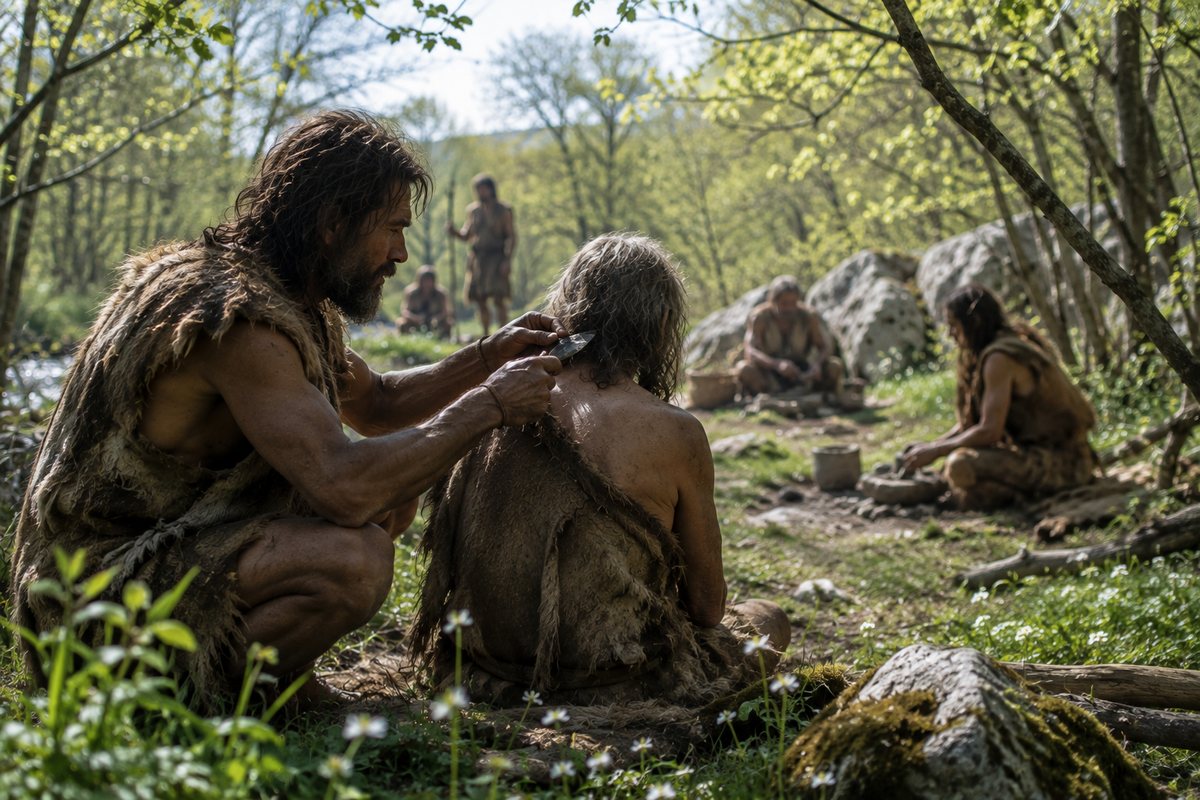
Working around the back of the head, controlling a sharp edge near difficult areas or creating deliberate patterns all become easier with assistance.
It is therefore possible that interpersonal grooming included hair removal as well as combing, cutting and arranging.
But we should stop there.
Calling such a person a “prehistoric barber” would imply a professional or recognised social role that the available evidence cannot establish.
The profession belongs later in our story.
The behaviours that eventually made the profession possible are much older.
From Sharp Stone to the Razor
The origins of shaving reveal how misleading the history of an everyday object can become when we focus only on its familiar modern form.
Humans did not need a steel razor to discover hair removal.
Long before metallurgy, they possessed cutting technologies capable of producing extremely sharp edges. Flint and other stone materials created the technological possibility of cutting hair close to the body.
What archaeology cannot yet give us is the first shaving event.
We do not know who performed it, where it happened, which part of the body was involved or what motivated the decision.
Nor should every sharp prehistoric flake be transformed into a razor simply because it could cut hair.
The strongest conclusion is more measured and, ultimately, more revealing.
Shaving probably emerged from technologies that already existed for other purposes. Over time, grooming became sufficiently important for specialised tools to develop. With the appearance of metal razors, hair removal becomes increasingly visible as a distinct activity in the archaeological record.
The metal razor therefore did not necessarily create shaving.
It gave an ancient human practice a tool of its own.
Next in the History of Hairdressing: Hair and Human Identity in Prehistoric Society
Cutting, combing and removing hair show that prehistoric humans possessed the technological ability to transform their appearance.
But technology explains only part of the story.
Why did hair matter enough for people to spend time cutting it, arranging it, decorating it or removing it?
To answer that question, we must move beyond tools and examine hair itself as part of the way humans communicated who they were.
More from History for Hairdressers
 Chapter 1Before the Hairdresser: The Prehistoric Origins of Hair CarePrehistory & OriginsLong before salons, scissors and professional hairdressers, humans were already managing and transforming th...Read chapter →
 Chapter 2The First Haircut: How Prehistoric Humans Cut Their HairPrehistory & OriginsThousands of years before scissors and metal razors, humans already possessed edges sharp enough to cut hair...Read chapter →
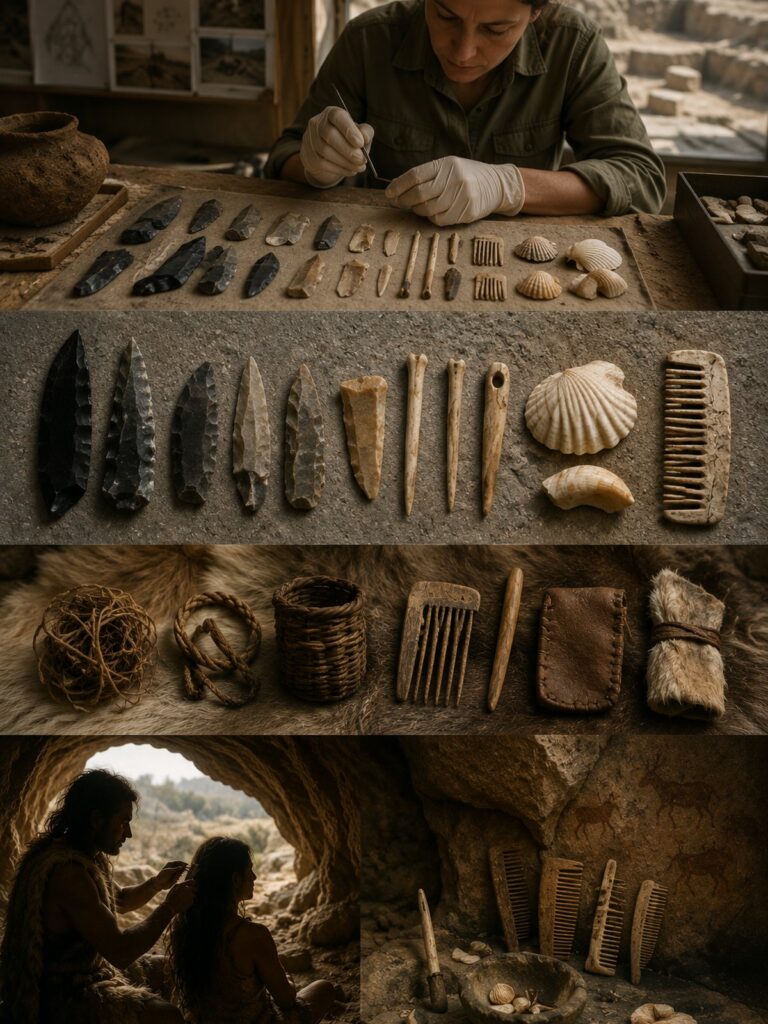 Chapter 3The First Hair Tools: Stone, Flint, Shell and BonePrehistory & OriginsDiscover the earliest materials prehistoric humans could use for hair care, from sharp flint and stone to sh...Read chapter →
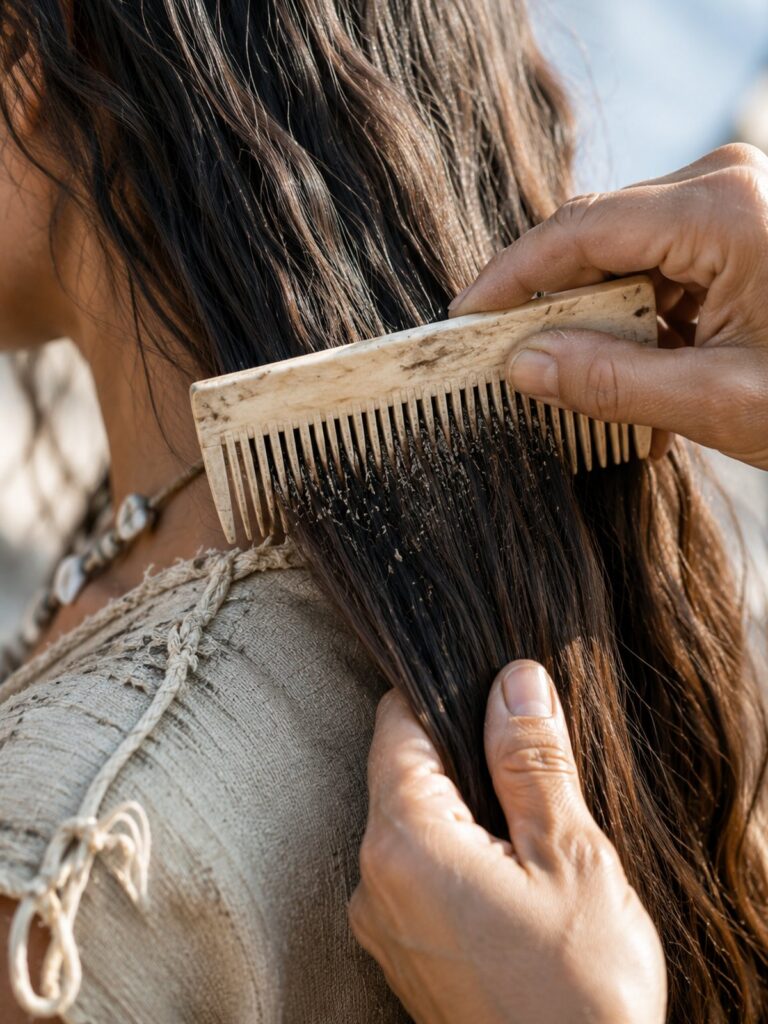 Chapter 4The Origins of Combs: Humanity’s First Hair-Care ToolPrehistory & OriginsDiscover the origins of combs, from prehistoric toothed tools to ancient bone and ivory combs that reveal th...Read chapter →
 New chapterHair and Human Identity in Prehistoric SocietyPrehistory & OriginsExplore prehistoric hair identity and how hairstyles, grooming and hair representation may have expressed in...Read chapter →