Decorating the Hair: The First Hair Ornaments
History of Hairdressing · Prehistory & Origins · Chapter 9
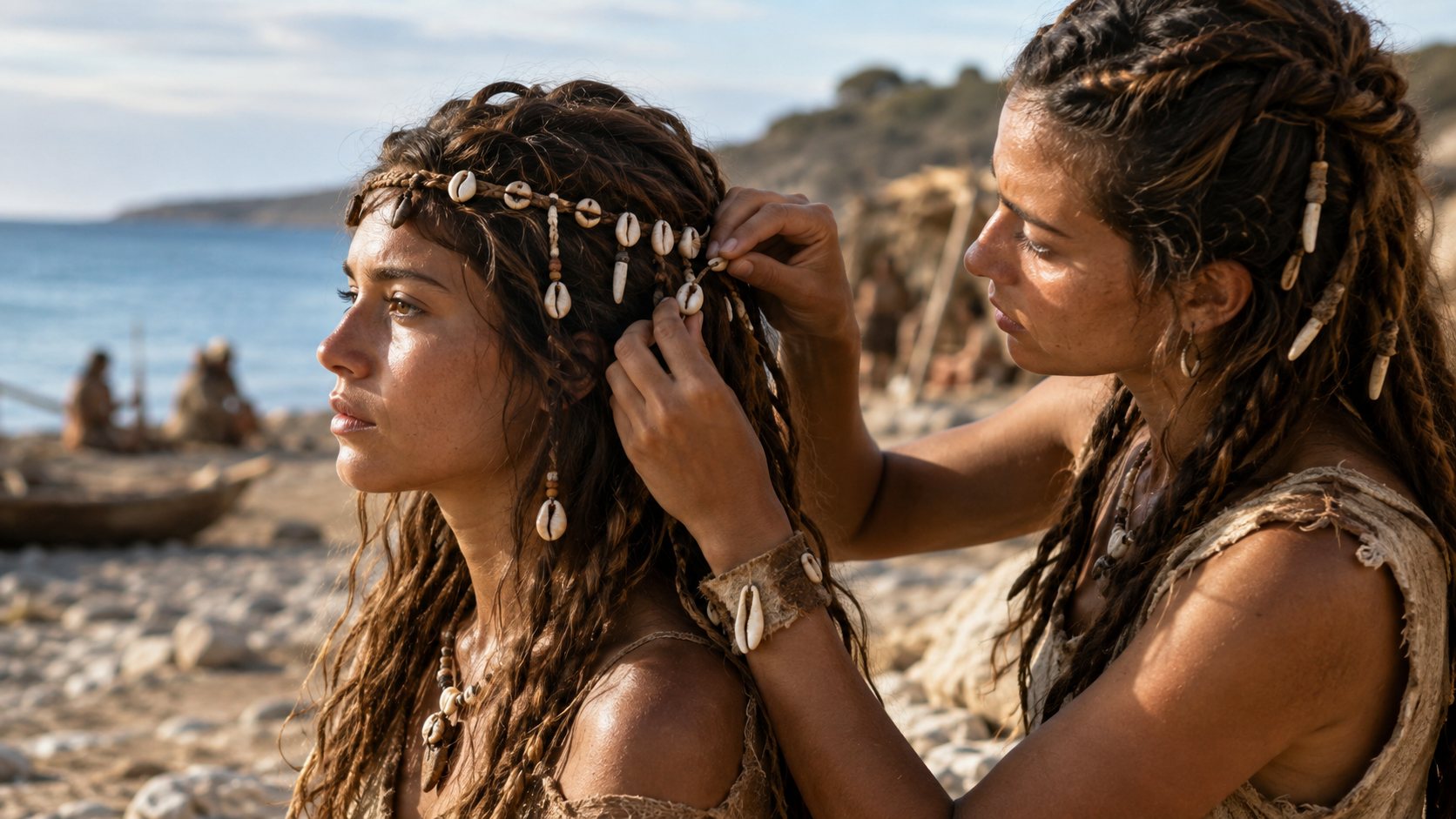
Long before metal hairpins, jeweled combs and decorative clips became familiar objects, humans had already discovered that the head could be transformed through ornament. Shells, animal teeth, bone, ivory and carefully made beads became part of a visual language that extended beyond basic grooming. Somewhere within this much older tradition lies the beginning of what we now think of as hair decoration.
Finding the first hair ornaments, however, is far more difficult than finding the earliest beads.
Archaeologists have discovered personal ornaments dating back well over 100,000 years, but an ancient perforated shell does not tell us where it was worn. It might have formed part of a necklace, garment, bracelet, head covering or another object that has disappeared. Hair itself rarely survives, while the organic cords, leather, fibres and fabrics that may once have held ornaments in position usually vanish as well.
The history of hair ornamentation therefore begins with uncertainty. Yet as archaeological evidence becomes richer, particularly when ornaments survive in their original positions around human remains, a remarkable story emerges. People were not simply cutting, arranging and caring for their hair. They were beginning to make the head a visible space for decoration.
Before Hair Ornaments Came Personal Ornaments
The deeper history of hair decoration belongs to the broader history of human adornment.
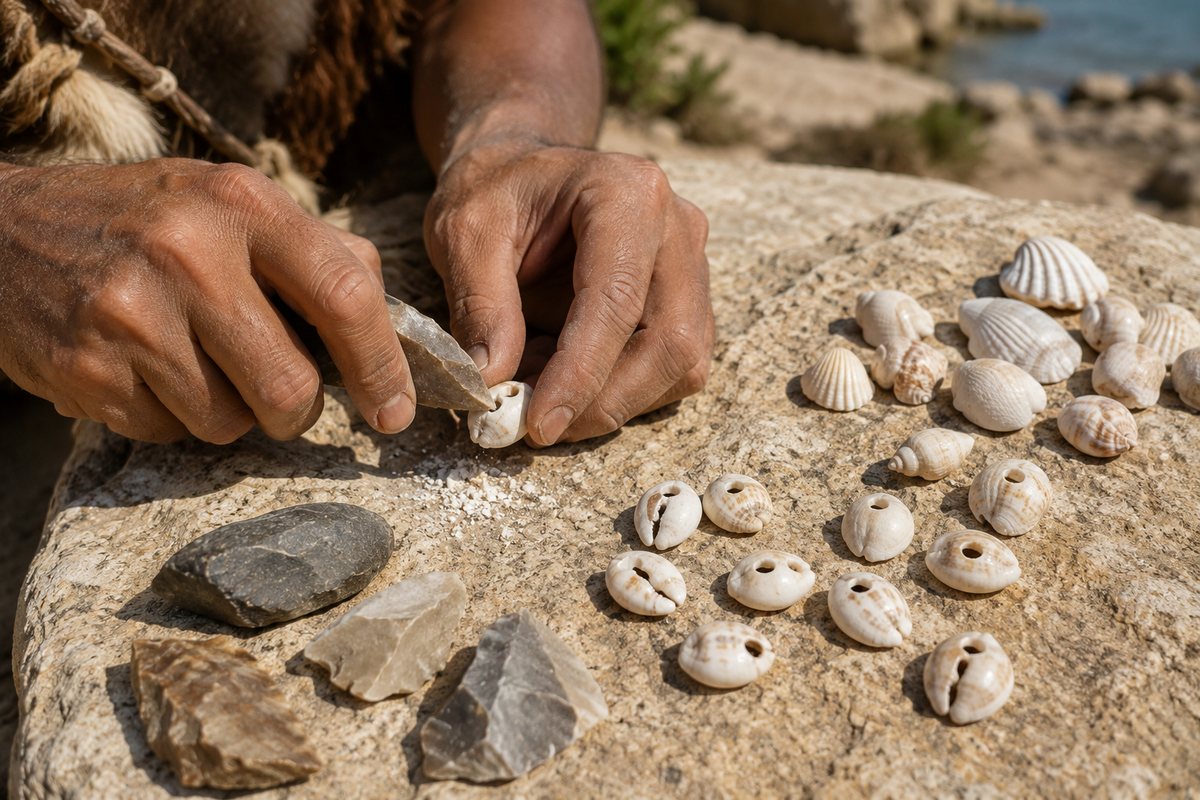
Some of the earliest convincing personal ornaments are perforated marine shells found at African archaeological sites. Finds from Bizmoune Cave in Morocco have been dated to at least approximately 142,000 years ago, placing deliberate personal ornamentation extraordinarily deep in human prehistory.
These objects are important because they show that people were modifying small natural materials so that they could be suspended or attached. A shell was no longer simply something collected from the environment. It could become part of a person’s appearance.
What archaeology cannot tell us is whether these extremely early ornaments decorated the hair.
A perforated shell without its original string, garment or position on the body cannot reliably be classified as a hair ornament. This distinction is essential. The origins of personal adornment may be very ancient, but the evidence for decoration specifically associated with the head develops much more gradually.
Why the First Hair Ornaments Are So Difficult to Identify
Hair decoration presents archaeologists with a preservation problem.
Consider a simple prehistoric headband made from plant fibre or hide, decorated with ten perforated shells. Thousands of years later, the headband may have completely decomposed. The shells could remain.
The same problem applies to ornaments braided into hair. Hair may disappear. The cord holding the ornaments may disappear. The hairstyle itself certainly disappears. What remains is a collection of durable objects whose original arrangement can be extremely difficult to reconstruct.
This is why archaeological context matters as much as the ornament itself.
When beads are discovered scattered through disturbed soil, their original position may be unknowable. When they remain concentrated around the skull of an undisturbed burial, the evidence becomes much more informative.
Even then, caution remains necessary. Ornaments around the skull may have decorated the hair, but they might instead have been attached to a cap, hood, band, net or another form of headwear.
The distinction between a hair ornament and a head ornament is sometimes impossible to recover after thousands of years.
Shells: One of Humanity’s Earliest Decorative Materials
Shells occupy an exceptional place in the archaeology of personal adornment.
They were naturally attractive, relatively durable and available in forms that could be perforated, suspended or arranged into repeating patterns. Some prehistoric communities transported marine shells far from the coast, showing that their significance could extend beyond simple access to a convenient material.
By the Upper Palaeolithic, shell ornaments occur across a wide geographical area. Sites such as Üçağızlı Cave in present-day Türkiye and Ksar ’Akil in Lebanon contain important assemblages of marine shell beads associated with early Upper Palaeolithic populations.
These discoveries demonstrate increasingly established traditions of personal ornamentation.
They do not, by themselves, reveal hairstyles.
Yet shells would eventually become particularly important in prehistoric decoration associated with the head. Their durability allows archaeologists to reconstruct arrangements long after the material that originally supported them has vanished.
In that sense, the shell became one of the materials through which the invisible history of prehistoric appearance can occasionally become visible again.
Teeth, Bone and Ivory Expanded the Decorative Vocabulary
Prehistoric ornamentation was never limited to shells.
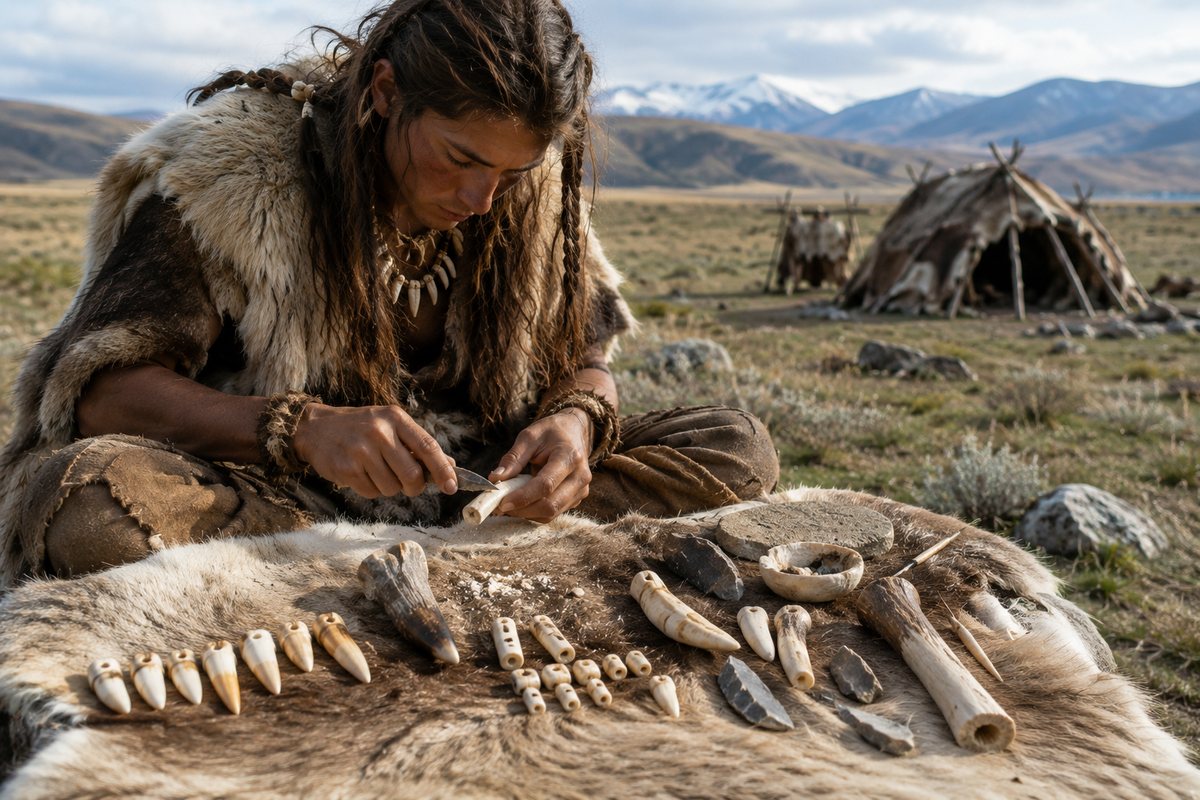
Animal teeth could be perforated and suspended. Bone could be cut, shaped and polished. Ivory offered another workable material capable of being transformed into beads, pendants and other decorative objects.
These materials demonstrate an important development in the history of adornment. Humans were increasingly manufacturing decorative forms rather than relying only on naturally attractive objects.
The process required decisions.
A material had to be selected. It might need to be cut or perforated. Its surface could be shaped or polished. Individual elements could then be arranged with others.
The surviving object therefore represents more than decoration. It preserves evidence of craftsmanship.
For the history of hairdressing, this matters because elaborate hair ornamentation requires exactly this relationship between material, technique and appearance. Before specialized hair accessories could develop, humans first had to establish the much broader practice of manufacturing objects intended to alter how the body was seen.
Sunghir and the Decorated Palaeolithic Head
One of the most extraordinary windows into Palaeolithic personal appearance comes from Sunghir in Russia.
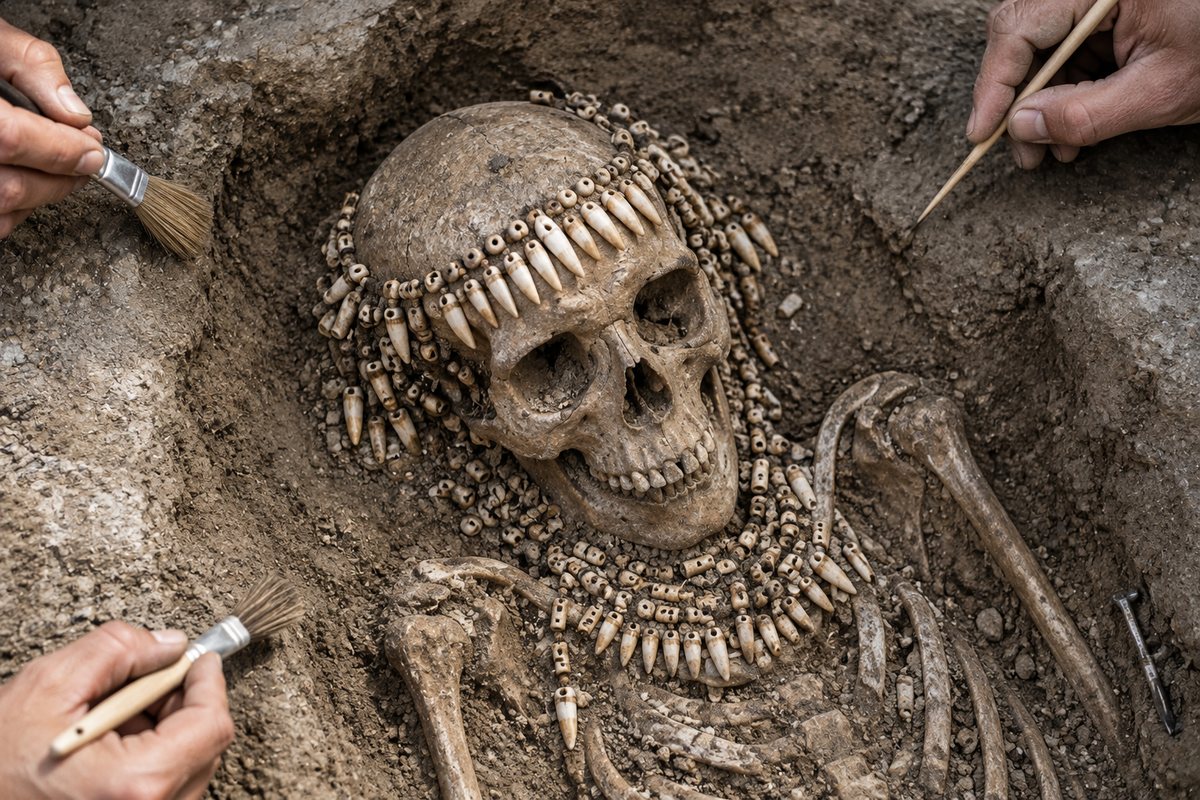
The Upper Palaeolithic burials discovered there contained an exceptional quantity of ornamentation, including thousands of carefully manufactured mammoth ivory beads and perforated animal teeth.
Of particular importance for the history of head decoration is the position of some ornaments.
In the burial known as Sunghir 1, twelve perforated Arctic fox teeth were found arranged across the forehead. Another individual, Sunghir 2, had more than forty perforated fox teeth associated with the skull area.
This is fundamentally different from discovering an isolated bead.
The archaeological position connects the ornaments directly with the head.
What it does not prove is that they were attached directly to hair.
They may have decorated a cap, hood, band or another support. Some of the enormous number of beads found at Sunghir are interpreted as having been attached to clothing, demonstrating how extensively garments themselves could be ornamented.
Sunghir therefore gives us strong evidence for a decorated head, but not a perfectly preserved prehistoric hairstyle.
That distinction makes the site more useful, not less. It shows precisely how archaeology can reveal personal appearance while still leaving important details unresolved.
When the Head Became a Surface for Display
The importance of decorating the head is easy to understand visually.
The human head is one of the most immediately visible parts of the body. Hair changes its outline, movement and texture. Adding contrasting objects can transform it even further.
A row of pale shells against dark hair, polished teeth positioned across the forehead or beads surrounding the head would have produced an appearance noticeably different from undecorated hair or headwear.
We can recognize that visual effect without claiming to know its exact social meaning.
An ornament might have communicated identity, group affiliation, age, achievement, personal preference or something entirely different. Different communities almost certainly created different meanings.
Archaeology can sometimes reconstruct the physical arrangement of an ornament.
Recovering the ideas attached to that arrangement is much harder.
The safest conclusion is also one of the most interesting: prehistoric humans were developing increasingly complex ways of making personal appearance visible and distinctive.
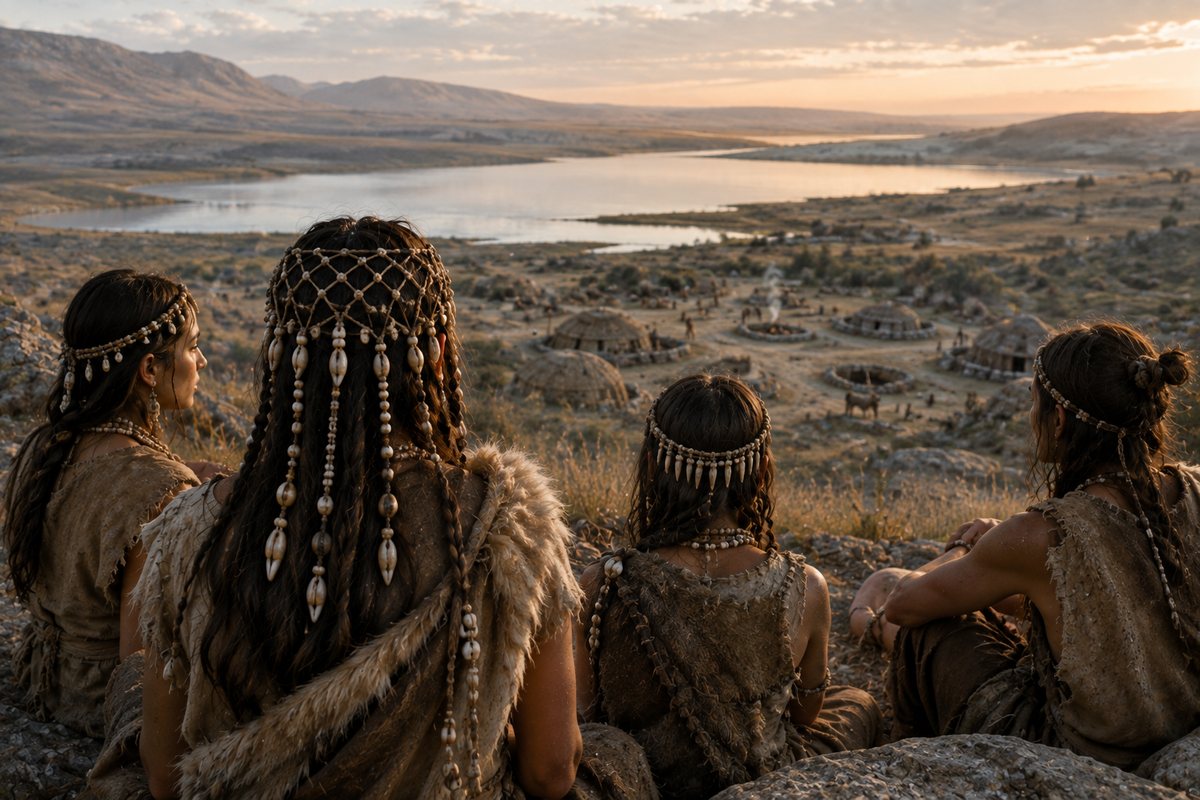
Natufian Headdresses Bring the Evidence Into Sharper Focus
Thousands of years after the earlier Palaeolithic examples, Natufian communities of the Levant provide particularly striking evidence for elaborate head decoration.
The Natufian period is important because archaeological burials sometimes preserve ornaments in arrangements that allow researchers to reconstruct how they may originally have been worn.
At Eynan, also known as Ain Mallaha, a female burial provides evidence of a remarkable headdress decorated with hundreds of Dentalium shells.
This is no longer simply an isolated perforated shell whose position on the body is unknown.
The relationship between the ornaments and the head is much clearer.
Other Natufian sites provide additional examples of shells, beads and pendants concentrated around skulls. Together, they show that decorating the head could involve carefully organized compositions rather than a single suspended object.
The history of the first hair ornaments is therefore also a history of arrangement.
Individual beads mattered, but so did their placement.
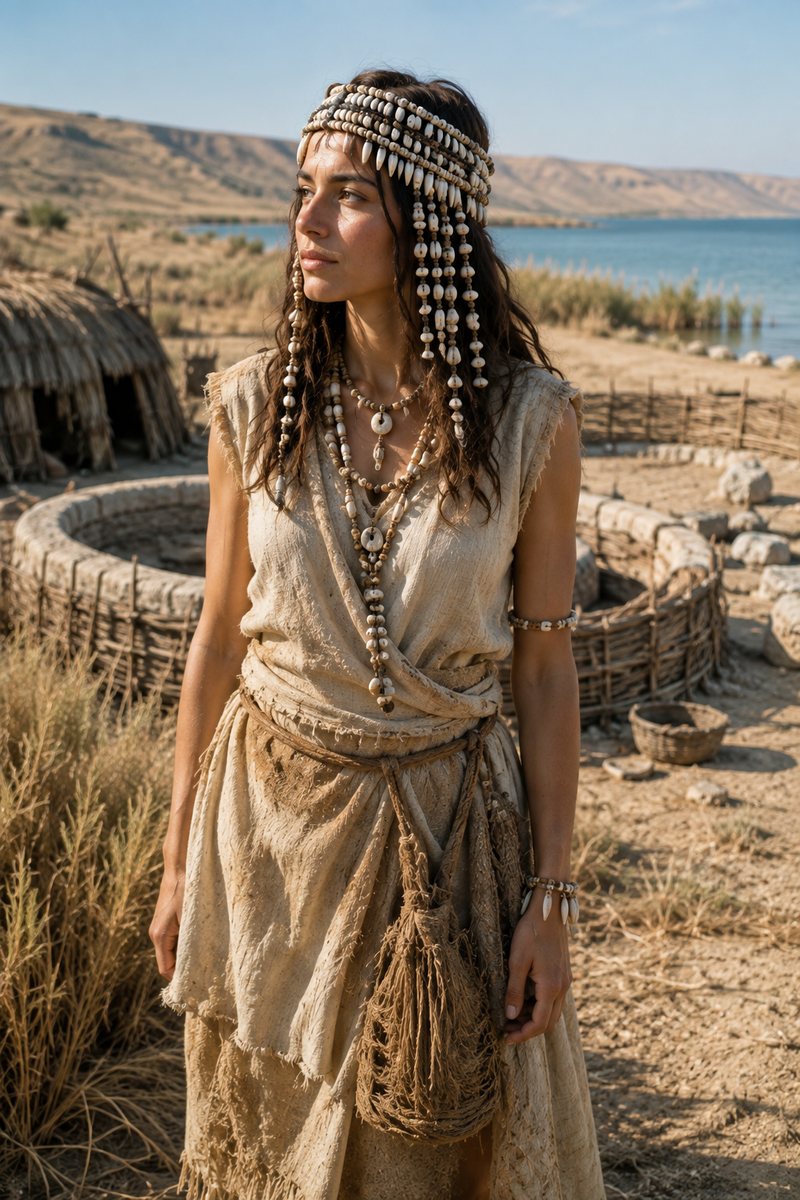
El-Wad and the Reconstruction of Beaded Headwear
Evidence from the Natufian cemetery at el-Wad adds another layer to this story.
Researchers examining original burial documentation have reconstructed possible arrangements of Dentalium shell beads associated with several skulls.
One burial is particularly striking because multiple rows of beads were positioned beside the skull. Such arrangements have been interpreted as potentially belonging to decorated headwear or a multi-row band.
These reconstructions demonstrate both the possibilities and limitations of archaeological interpretation.
We can observe where durable ornaments were found.
We can calculate how they were distributed.
We can compare their orientation and position.
But the material that connected them may no longer exist.
A reconstructed beaded band is therefore an evidence-based interpretation rather than a photograph of prehistoric reality.
This distinction is crucial when imagining prehistoric hairstyles. Archaeology gives us fragments of appearance, not complete portraits.
Hair, Headbands, Caps or Nets?
One question follows almost every prehistoric head ornament: what actually held it in place?
There are several possibilities.
Beads could have been attached to a headband. They could have decorated a cap or hood. They might have been sewn onto a net. Some ornaments may have been tied directly into hair or incorporated into braids.
The archaeological record usually cannot distinguish between all these possibilities.
This uncertainty should not be treated as a weakness in the history of hairdressing. Instead, it reveals something fundamental about prehistoric grooming culture.
Hair did not exist separately from everything worn around it.
A hairstyle, headband, covering and ornament could work together to create a single appearance. The modern distinction between a hair accessory and an item of clothing may therefore be less useful when examining prehistoric societies.
The earliest history of hair decoration may have been a history of complete head styling.
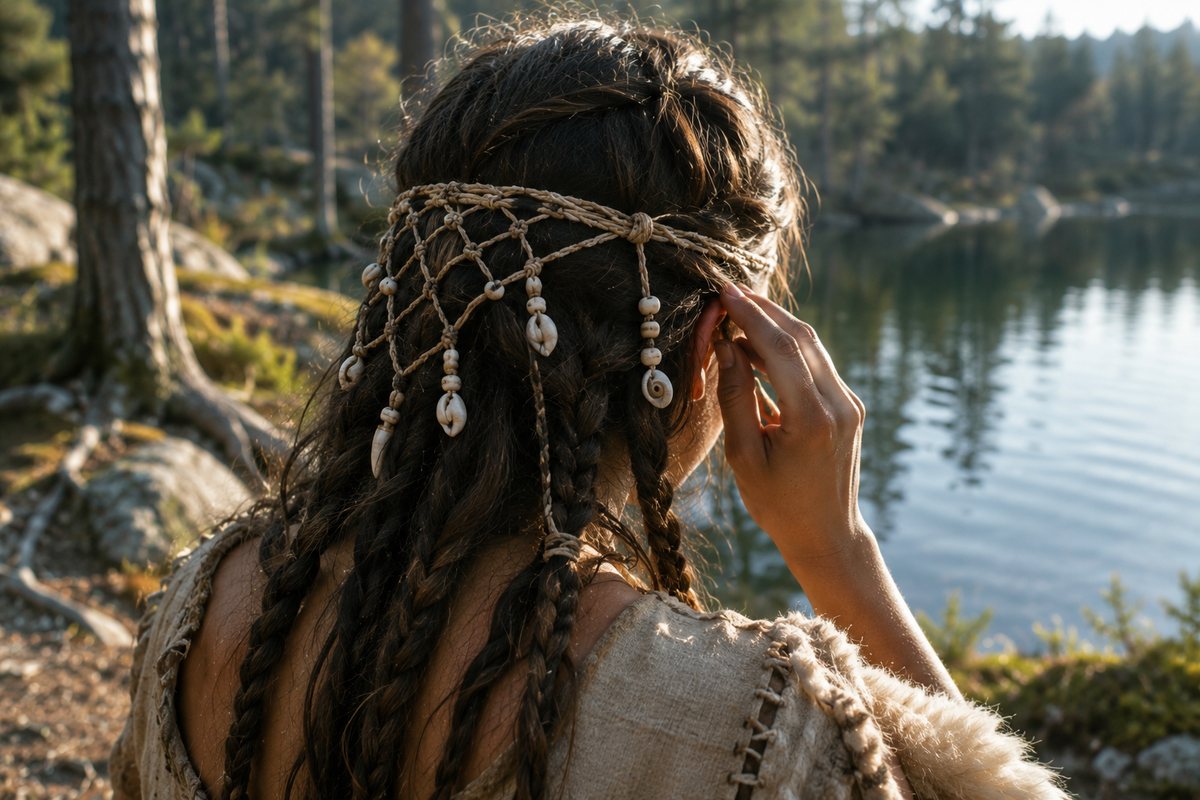
Decoration Was Not Exclusively Female
Modern assumptions can easily distort interpretations of prehistoric appearance.
Hair ornaments are often associated primarily with women in contemporary fashion imagery, but prehistoric archaeology does not support a simple female-only model of head decoration.
Ornaments associated with the head occur with individuals of different ages and sexes.
Sunghir alone demonstrates why caution is necessary. Richly ornamented burials include adults and children, and head-associated ornaments cannot be reduced to a single gender category.
This matters for the broader history of hairdressing.
Personal appearance has never belonged exclusively to one sex. Cutting, grooming, arranging and decorating hair could participate in many different forms of identity.
The archaeological evidence does not allow us to reconstruct universal rules about who was permitted to wear particular ornaments.
What it does allow us to reject is the assumption that prehistoric hair decoration was simply an early form of women’s jewelry.
What Did Prehistoric Hair Ornaments Mean?
This may be the most tempting question and the most dangerous one to answer too confidently.
A spectacular ornament immediately encourages interpretation.
Was it a symbol of status?
Did it identify a family or community?
Was it connected with marriage?
Did it have spiritual meaning?
Was it worn only during ceremonies?
Any of these possibilities might have existed in particular societies. None should automatically be assigned to an archaeological object without supporting evidence.
Personal ornaments are widely studied as potential forms of social communication because visible objects can distinguish individuals and groups. Differences in material, arrangement and craftsmanship may have carried information recognizable to people within a community.
But the exact message usually disappeared with the people who understood it.
A shell around the head can survive for thousands of years.
Its meaning cannot.
The responsible history of prehistoric hair decoration therefore has to preserve the boundary between evidence and imagination.
From Personal Adornment to the First Hair Ornaments
There may never be a single archaeological object that can confidently receive the title of the world’s first hair ornament.
The evidence does not work that way.
Instead, we can see a long sequence.
Humans began using personal ornaments extremely early. Over time, archaeological contexts reveal increasingly sophisticated combinations of shells, teeth, bone, ivory and beads. Eventually, the positions of these objects around skulls provide clear evidence that the head itself was being deliberately decorated.
Whether every surviving ornament touched the hair directly is another question.
Some almost certainly belonged to headwear. Others may have been integrated with hair. Many cases will remain permanently uncertain because the organic materials connecting ornament and body have disappeared.
This makes the origins of hair ornamentation less like the invention of a single object and more like the development of an idea.
Hair and the head had become places where humans could create appearance.
That development represents an important step in the history of hairdressing. Grooming was no longer concerned only with controlling, cutting or arranging hair. Decoration introduced another possibility: hair could become a setting for objects chosen because of how they looked.
Long before the jeweled hairpins of ancient civilizations, people were already discovering the visual power of decorating the human head.
Next in the History of Hairdressing: Prehistoric Hairstyles, What Archaeology Can Actually Tell Us
Ornaments reveal that prehistoric humans could transform the appearance of the head, but they still leave one major question unanswered.
What did prehistoric hairstyles themselves actually look like?
Archaeology rarely preserves hair, and artistic representations must be interpreted carefully. Yet surviving human remains, tools, figurines and other evidence provide clues that allow us to separate what can genuinely be known from what modern imagination has added.
More from History for Hairdressers
 Chapter 1Before the Hairdresser: The Prehistoric Origins of Hair CarePrehistory & OriginsLong before salons, scissors and professional hairdressers, humans were already managing and transforming th...Read chapter →
 Chapter 2The First Haircut: How Prehistoric Humans Cut Their HairPrehistory & OriginsThousands of years before scissors and metal razors, humans already possessed edges sharp enough to cut hair...Read chapter →
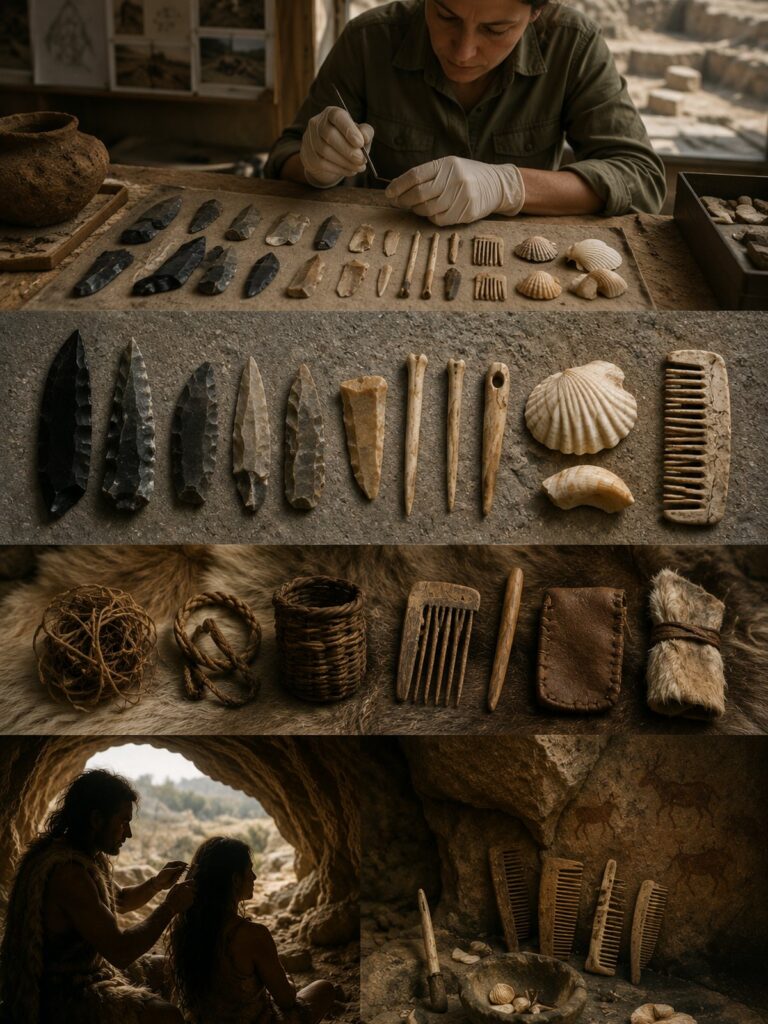 Chapter 3The First Hair Tools: Stone, Flint, Shell and BonePrehistory & OriginsDiscover the earliest materials prehistoric humans could use for hair care, from sharp flint and stone to sh...Read chapter →
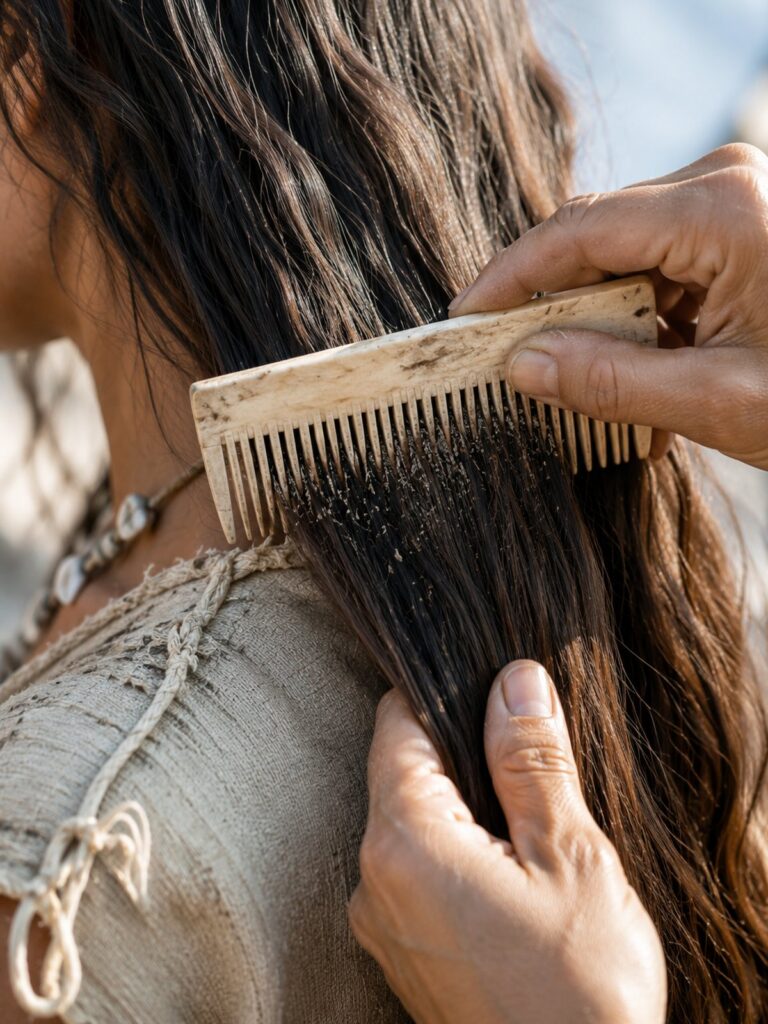 Chapter 4The Origins of Combs: Humanity’s First Hair-Care ToolPrehistory & OriginsDiscover the origins of combs, from prehistoric toothed tools to ancient bone and ivory combs that reveal th...Read chapter →
 Chapter 5The Origins of Shaving: Before the Metal RazorPrehistory & OriginsExplore the origins of shaving and how sharp stone and flint may have allowed prehistoric humans to remove h...Read chapter →
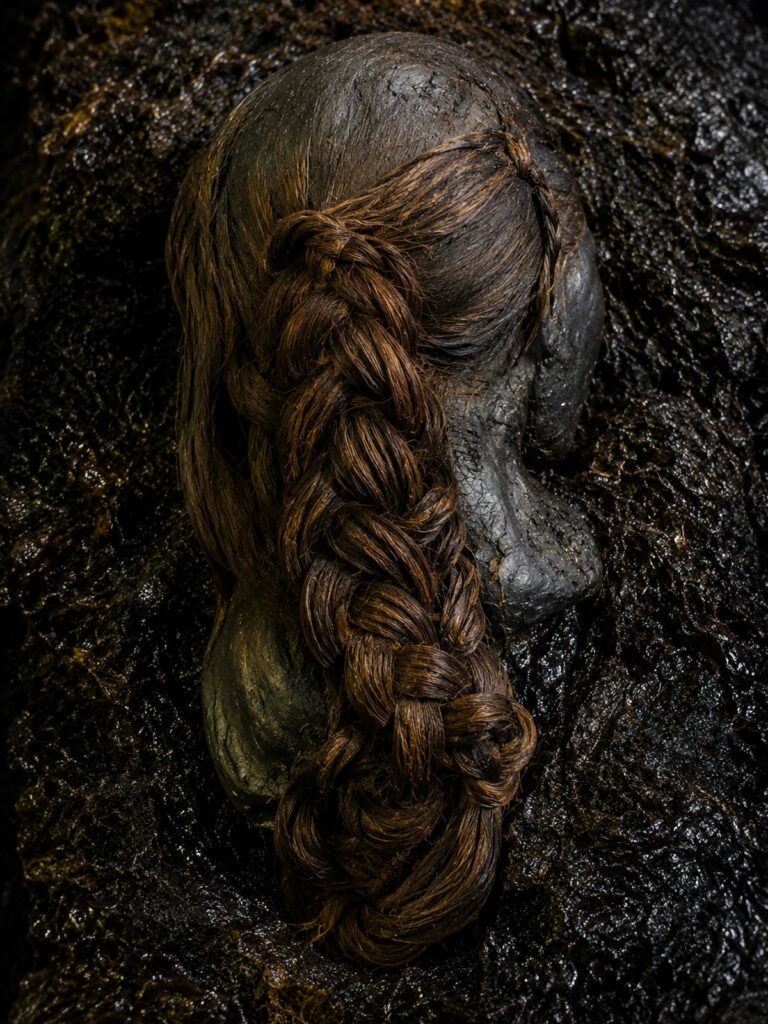 Chapter 6Hair and Human Identity in Prehistoric SocietyPrehistory & OriginsExplore prehistoric hair identity and how hairstyles, grooming and hair representation may have expressed in...Read chapter →
 Chapter 7The Ancient Origins of BraidingPrehistory & OriginsExplore the origins of braiding, from possible Paleolithic representations of complex hairstyles to preserve...Read chapter →
 Chapter 8Hair, Ritual and Spiritual Meaning Before Written HistoryPrehistory & OriginsExplore prehistoric hair rituals and archaeological evidence for cutting, preserving and depositing hair, wh...Read chapter →