From Prehistory to the First Hairdressers: The Birth of a Profession
History of Hairdressing · Prehistory & Origins · Chapter 12
The first hairdresser has no name.
There is no surviving prehistoric document identifying the first person who became especially skilled at cutting, arranging or caring for another person’s hair. Archaeology has preserved no appointment book, no workshop sign and no written description of the moment when hair care became a specialized occupation.
That moment probably never existed as a single event.
Professions develop gradually.
Long before anyone could be identified as a hairdresser, humans already possessed the essential elements of hairdressing. They had hair that could be cut and shaped. They had sharp tools. They could bind, twist and braid flexible materials. They created personal ornaments. They modified appearance with pigments and decorative objects. They lived in communities where knowledge could be observed, learned and passed from one person to another.
Most importantly, people could work on someone else’s hair.
That simple relationship, one person possessing a skill and another receiving it, contains the earliest foundation of the profession.
The history of the first hairdressers therefore begins before professional hairdressers can actually be documented.
It begins with specialization.
Hair Care Was First a Shared Human Skill
For most of prehistory, hair care was probably part of ordinary social life.
People did not need a professional specialist to perform basic grooming.
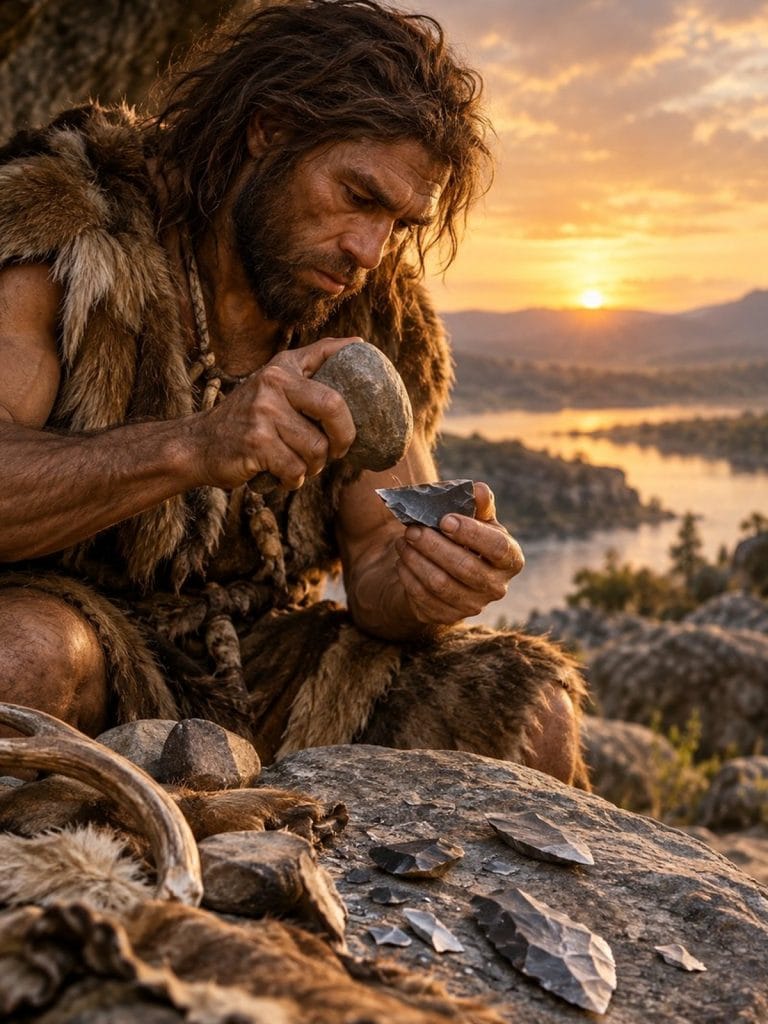
Hair could be shortened with a suitable cutting edge. Long sections could be gathered with fibre or leather. Fingers could separate hair. Another person could help remove tangles, divide sections or create arrangements that were difficult to reach alone.
These activities could take place within families and communities.
There is no reason to assume that every person performed them equally well.
Human skills are rarely distributed evenly.
One person may produce a better stone blade than another. Someone may be particularly skilled at working bone. Another person may understand fibres, hides, pigments or ornaments better than other members of the group.
Hair would have been no different.
Once grooming involved learned techniques, differences in ability became possible.
That does not yet create a profession.
But it creates the first condition required for one.
Some people can become better at a task than others.
Working on Another Person’s Hair Changes Everything
There is an important difference between managing your own hair and arranging someone else’s.
Many simple grooming actions can be performed alone.
Complex arrangements are different.
The back of the head is difficult to see and reach. Dividing hair into regular sections is easier when another person performs the work. Braiding can become increasingly complicated as the number of sections grows. Attaching cords, bands or ornaments may require additional hands.
As hairstyles become more elaborate, cooperation becomes more useful.
This creates a new social interaction.
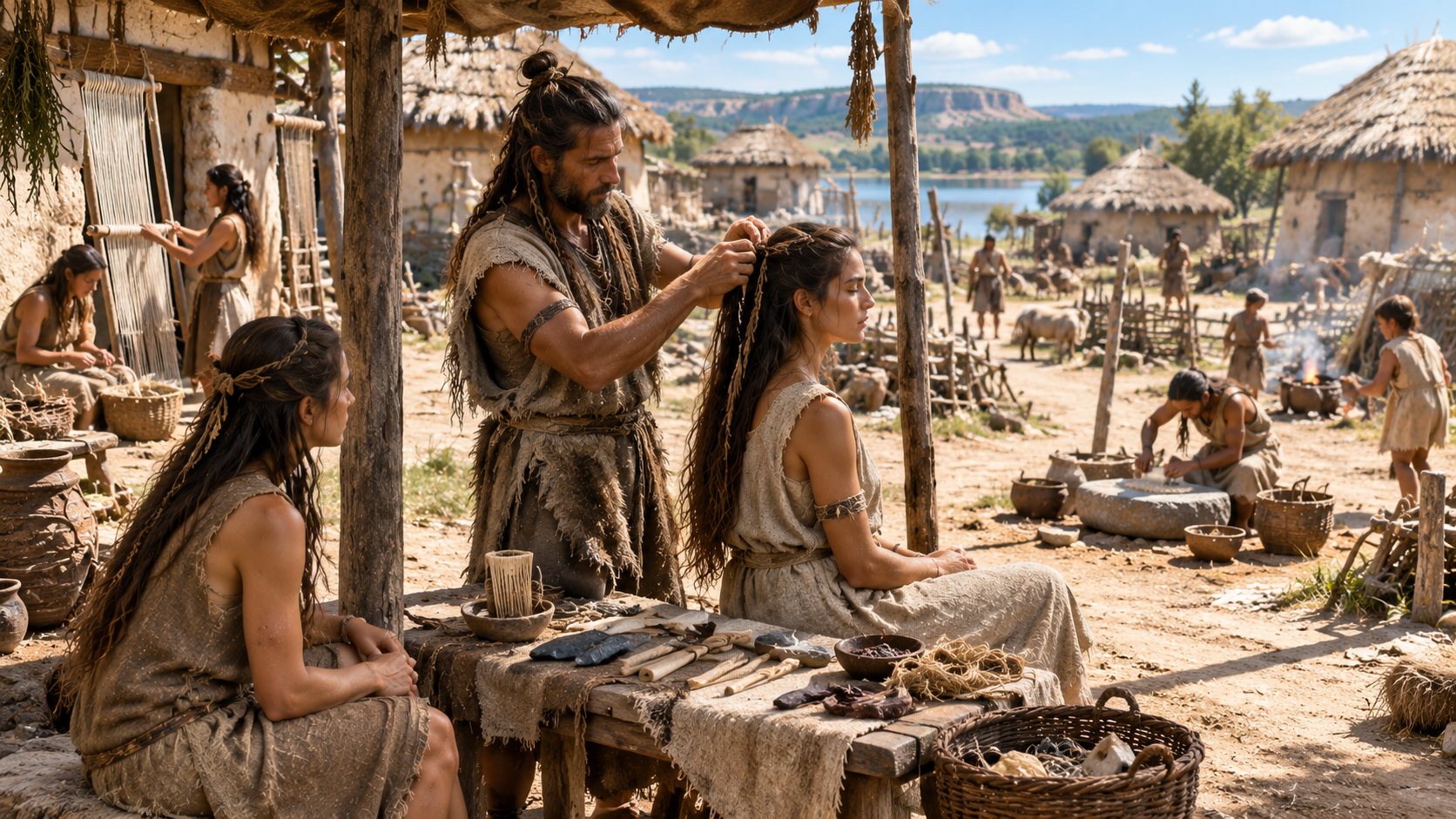
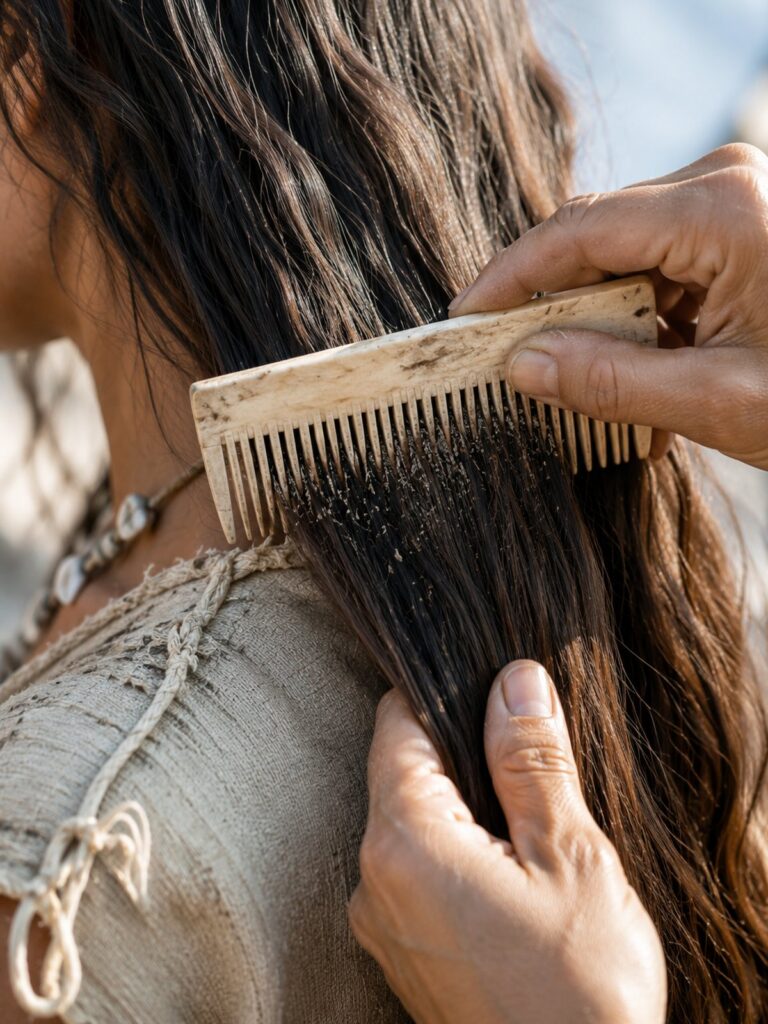
One person sits.
Another person works.
The person performing the work observes the hair, separates it, controls tension, repeats movements and produces a finished result.
The basic physical relationship is surprisingly similar to one that will define hairdressing throughout later history.
We cannot call every prehistoric person who helped arrange another person’s hair a hairdresser.
But the act itself matters.
Hair care had become something one person could perform for another.
Repetition Turns a Technique into Skill
Performing an action once does not make someone a specialist.
Repetition changes that.
A person who repeatedly cuts hair becomes more familiar with how different cutting edges behave.
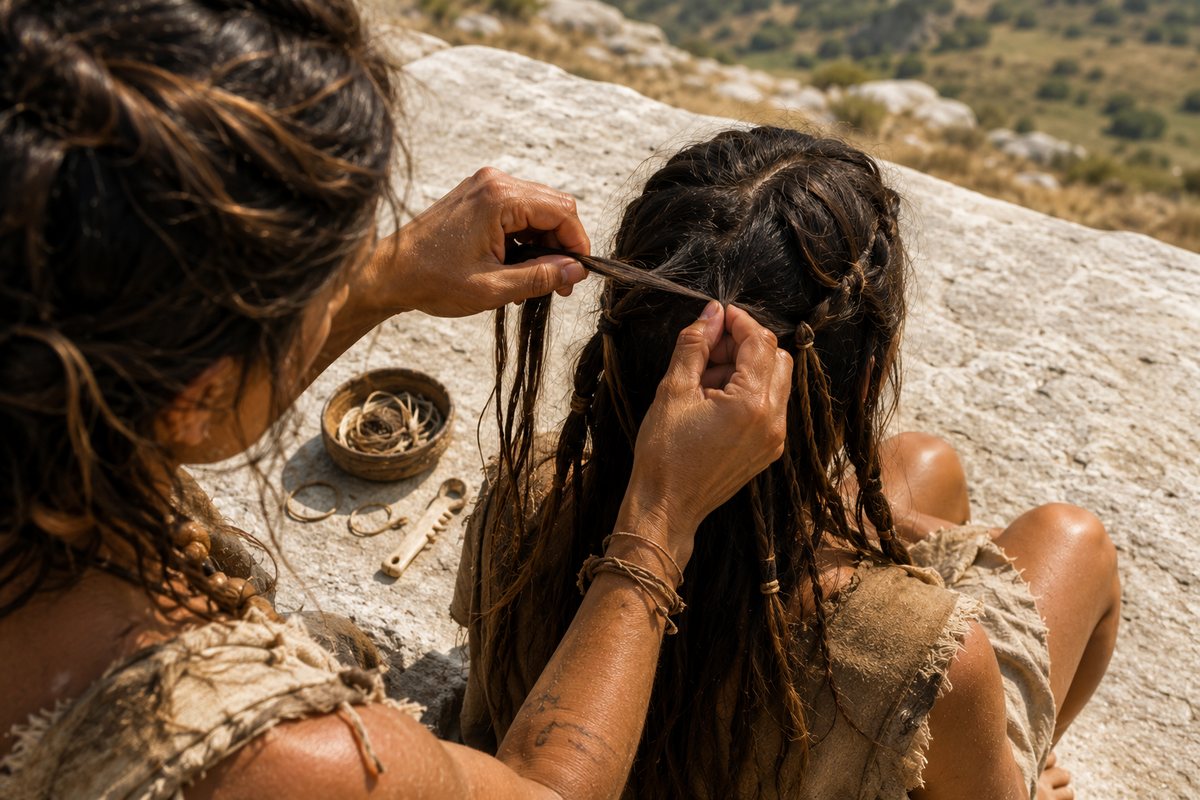
Someone who repeatedly braids learns how much tension is needed to keep sections secure.
A person who frequently ties or arranges long hair learns which methods remain stable during movement.
Experience produces efficiency.
It can also produce consistency.
This is one of the fundamental differences between an improvised action and a developed skill.
Prehistoric societies depended heavily on repeated knowledge.
Stone working required practice. Hunting techniques required practice. Preparing hides required practice. Making cordage, baskets, clothing, ornaments and tools required knowledge that could be learned and improved.
Hair techniques could follow the same process.
Nothing about hair makes it exempt from human specialization.
Once people cared enough about the finished appearance, repeated experience would become valuable.
Hair Knowledge Could Be Taught
A skill becomes culturally powerful when it can be transmitted.
Humans do not need written manuals to teach techniques.
Observation, demonstration, correction and repetition are enough.
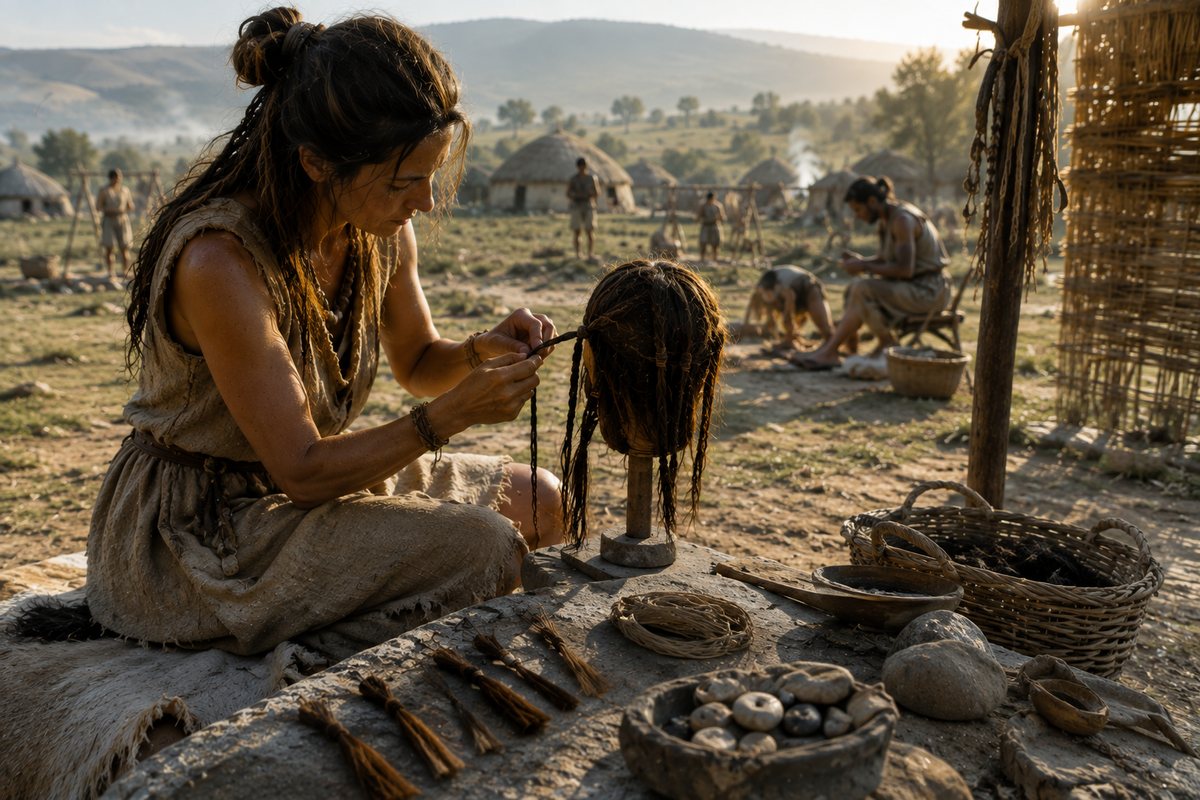
A younger person can watch how hair is divided.
They can observe where a cord is placed.
They can imitate a sequence of movements.
Someone more experienced can correct the result.
The same process allows technologies to survive across generations.
This is especially important for hair because many of the materials involved leave little archaeological evidence.
A stone tool can survive.
A hairstyle cannot.
A bone object may survive.
The movement of the hands that used it disappears.
A plant-fibre tie may decay completely.
The knowledge required to use it can nevertheless pass from person to person for centuries.
Hairdressing therefore has an unusual archaeological problem.
Its most important early evidence may not have been objects.
It may have been knowledge.
And knowledge does not fossilize.
More Complex Appearance Created More Complex Work
Earlier prehistoric grooming could be largely practical.
As personal appearance became increasingly deliberate, the demands placed on grooming could expand.
Hair could be more than shortened.
It could be divided.
It could be gathered.
It could be twisted.
It could be braided.
It could interact with cords, bands, head coverings and personal ornaments.
Each additional element increased the number of decisions required to create the finished appearance.
Where should the hair be divided?
How tightly should it be secured?
How should different sections be balanced?
Where should an ornament be attached?
How long will the arrangement remain stable?
These questions may sound surprisingly modern.
The technologies were not modern, but the problem was fundamentally similar.
Someone had to transform raw hair into an intended arrangement.
The more complicated that transformation became, the more useful experience would have been.
This is where grooming begins moving toward craft.
Specialization Does Not Immediately Mean Profession
The word profession must be used carefully.
A person can be exceptionally skilled at a task without earning a living from it.
They may perform it for relatives.
They may help members of a small community.
Their skill may be recognized socially without becoming a formal occupation.
This distinction is essential when discussing the first hairdressers.
Prehistoric archaeology rarely allows us to demonstrate that someone worked exclusively, or even primarily, as a hair specialist.
We should therefore avoid imagining a prehistoric salon or assigning modern job titles to people who left no written records.
Specialization probably existed on a spectrum.
At one end was ordinary self-grooming.
Then came assistance between people.
Beyond that was repeated skill.
Some individuals may have become particularly capable.
Only much later, within increasingly complex societies, could such specialization become a recognizable occupation.
The birth of hairdressing was therefore a process rather than an invention.
Larger Communities Changed the Possibilities
Small mobile groups and large settled communities create different opportunities for specialization.
As human societies became more settled in many regions, population size increased and economic systems became more complex.
Food production eventually allowed larger communities to support people whose activities were not limited to obtaining food every day.
Craft specialization became increasingly visible.
Potters, textile workers, builders, metalworkers and other skilled producers appear in different forms as societies develop greater divisions of labour.
Hair care existed within the same changing social world.
A larger population creates more potential clients for specialized personal services.
Greater social differentiation can increase the importance of visible appearance.
More complex clothing and ornament traditions can make personal presentation increasingly elaborate.
New materials create new possibilities.
Hair itself remains biologically the same.
The society surrounding it changes.
That change is crucial for the emergence of professional grooming.
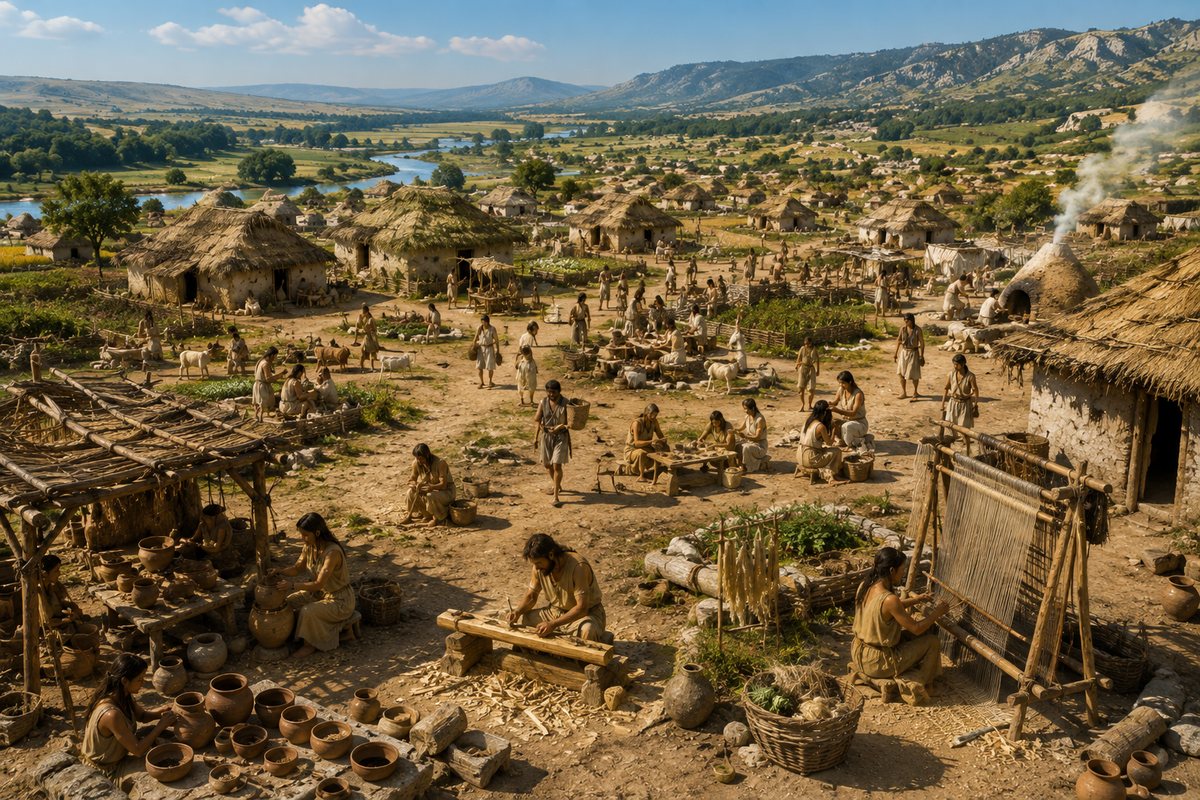
Settled Life Made Repeated Services More Practical
Mobility does not prevent skilled grooming.
But settled communities make repeated services easier to organize.
When people live together for extended periods, a skilled individual can repeatedly perform the same task for many members of the community.
Knowledge can accumulate.
Reputation can develop.
People can know who is particularly good at a particular activity.
This does not prove that the first settled villages contained professional hairdressers.
The archaeological evidence is not that precise.
But settlement changes the conditions under which specialization can develop.
A person who is recognized for a skill can serve a larger and more stable group.
Repeated interactions can also create expectations.
If one person consistently produces better results, others may seek that person’s assistance again.
That is an important step.
A useful skill is becoming a recognizable service.
New Tools Expanded What Hair Specialists Could Do
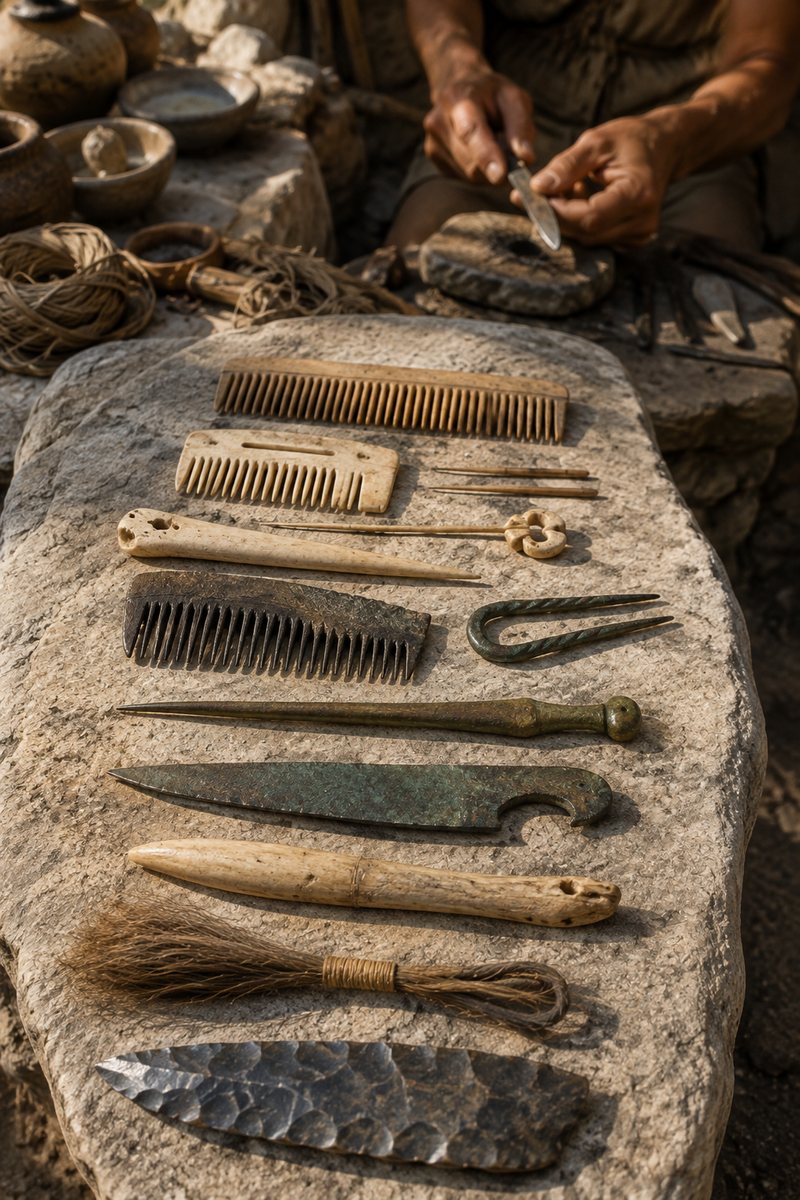
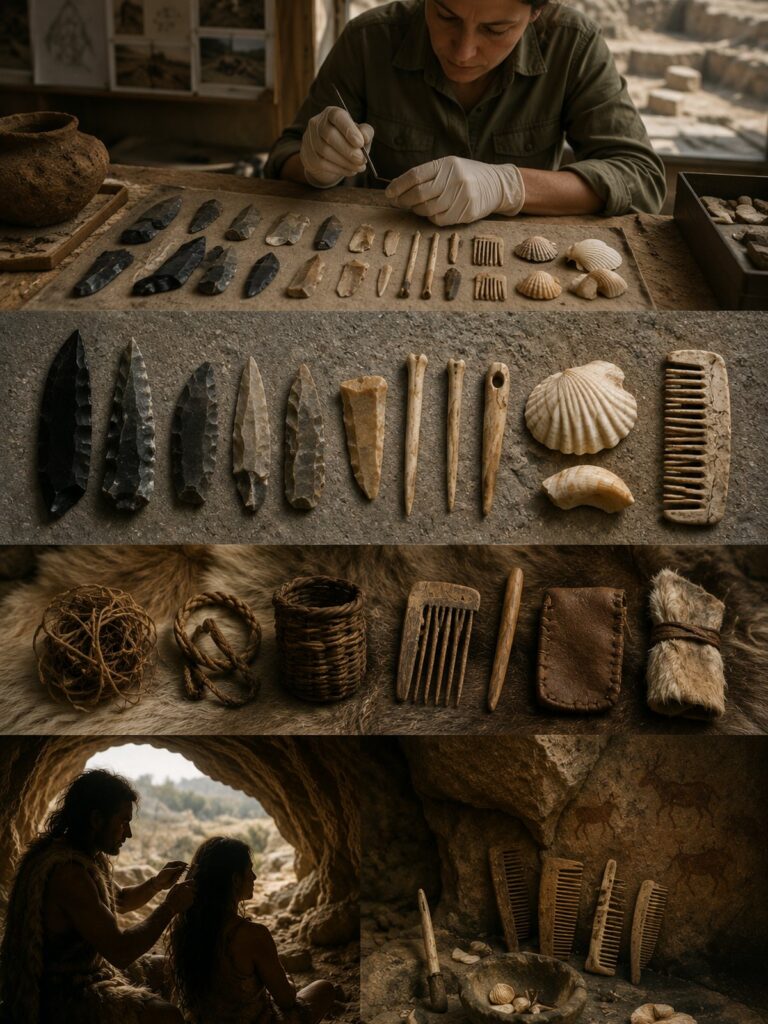
For most of deep prehistory, hair manipulation depended on stone, bone, wood, fibres and other natural materials.
Later technological development transformed the possibilities.
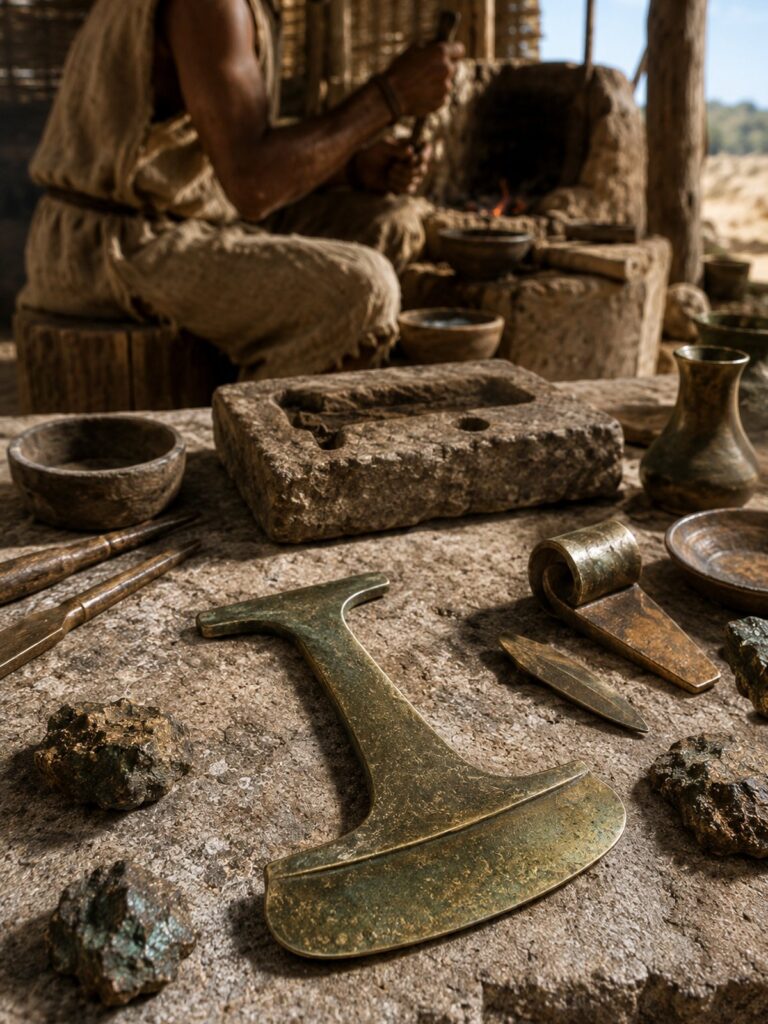
Metallurgy eventually introduced cutting edges and implements with properties different from stone.
Metal tools could be manufactured in specialized forms, repaired, sharpened and reproduced.
Combs also developed in increasingly varied forms across ancient societies.
Pins and other fastening devices could help secure arrangements.
Cosmetic containers, mirrors and specialized grooming objects became increasingly visible in the archaeological record of early civilizations.
These objects do not automatically identify the profession of the person using them.
But they change the material environment of grooming.
Hair care was acquiring a more extensive toolkit.
A larger toolkit allows more specialized practice.
Eventually, the relationship between skilled worker, specialized tools and repeated service becomes much easier to recognize historically.
The First Civilizations Make Hair Specialists More Visible
The transition from prehistory to written history changes our evidence dramatically.
Before writing, archaeologists reconstruct behaviour mainly from objects, human remains, settlement patterns, images and environmental evidence.
Writing adds names, occupations, institutions and descriptions.
Early civilizations also produced art showing increasingly detailed human appearance.
Hair can be represented in sculpture, reliefs and other visual sources.
Different hairstyles become visible.
Wigs, head coverings, grooming equipment and cosmetic practices can sometimes be studied alongside written and archaeological evidence.
Ancient Egypt is particularly important to the later history of hairdressing because the preservation of material culture, visual representation and written evidence provides an unusually rich picture of personal grooming.
But Egypt should not be mistaken for the sudden invention of hair care.
By the time historical civilizations allow us to see specialized grooming more clearly, humans had already been manipulating hair for an immense period of time.
History makes the hair specialist visible.
It does not create the underlying skill.
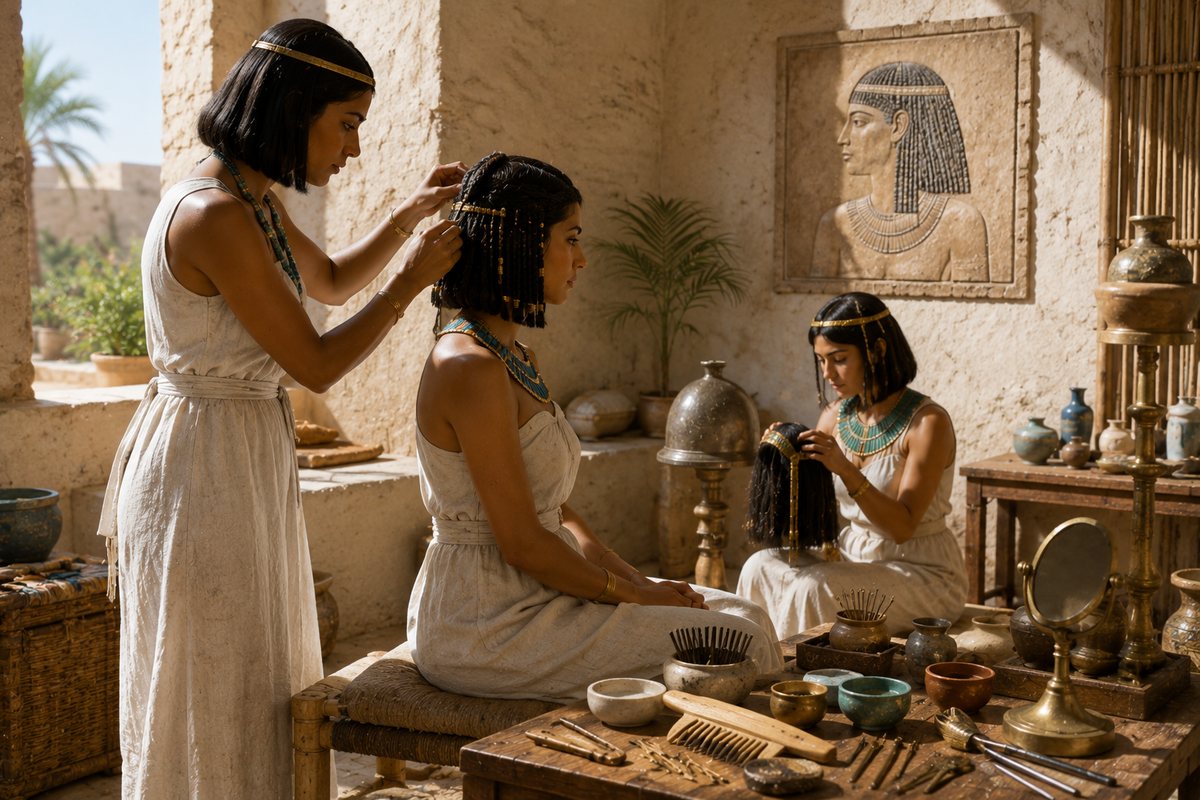
Ancient Egypt Shows How Far Specialization Could Develop
Ancient Egyptian society demonstrates what becomes possible once hair care exists inside a highly organized civilization.
Hair could be cut, shaved, arranged and supplemented with wigs and hairpieces.
Combs, hairpins and grooming equipment survive archaeologically.
Representations show carefully constructed appearances.
Specialized production was required for many objects associated with personal presentation.
Written and material evidence also begins to provide a social context that deep prehistory cannot.
This is where the story approaches people we can more reasonably discuss as occupational specialists.
Yet caution remains necessary.
The term hairdresser carries modern associations that do not map perfectly onto ancient social categories.
Hair care could overlap with shaving, wig making, personal service and other grooming activities.
Different specialists may have served different social groups or performed different tasks.
The important transformation is not the appearance of a modern salon.
It is the emergence of recognizable specialization around hair and grooming.
The profession is becoming historically visible.
Barbering and Hairdressing Were Not Originally Separate Worlds
Modern language often treats barbers and hairdressers as distinct professions.
Early grooming history is less tidy.
Cutting scalp hair, shaving facial hair, removing body hair, maintaining wigs and arranging hairstyles could belong to overlapping systems of personal care.
The boundaries changed across cultures and periods.
This makes searching for the “first hairdresser” even more difficult.
What exactly would qualify?
Someone who cut hair?
Someone who braided it?
Someone who shaved heads?
Someone who maintained wigs?
Someone who performed several of these activities?
The modern occupational definition cannot simply be projected backward.
It is more useful to think about early grooming specialists.
Within that broader category, the different branches of hair care gradually become clearer as historical evidence increases.
Hairdressing did not begin with a perfectly defined job description.
The profession itself had to evolve.
The First Hairdressers Were the Result of Thousands of Years of Knowledge
By the time recognizable hair specialists appear in historical societies, the knowledge behind their work was already ancient.
Stone cutting technology had existed for immense periods.
Humans had long understood fibres and binding.
Braiding technology was ancient.
Personal ornamentation reached deep into prehistory.
Hair could be tied, twisted, gathered and decorated without metal equipment.
People had also spent thousands of years developing increasingly complex systems of appearance and identity.
The first professional hair specialists therefore did not begin from nothing.
They inherited a vast body of human experimentation.
Some of that knowledge concerned tools.
Some concerned materials.
Much of it concerned hands.
How to hold hair.
How to divide it.
How to maintain tension.
How to repeat a pattern.
How to work on another person’s head.
These are forms of practical knowledge that can survive without leaving direct archaeological traces.
The profession was new.
Its foundations were prehistoric.
From Community Skill to Recognizable Occupation
The path toward professional hairdressing can therefore be understood as a sequence.
First came basic grooming.
Then humans developed tools capable of cutting and controlling hair.
People began deliberately arranging appearance.
Techniques became more complex.
Other people helped perform them.
Skills could be learned and transmitted.
Some individuals probably became better at particular tasks.
Larger and more settled societies created opportunities for repeated specialization.
Technological development expanded the available toolkit.
Social complexity increased the importance and variety of personal presentation.
Finally, written civilizations allow specialized grooming roles to become historically visible.
No single step created the hairdresser.
Together they created the conditions in which hairdressing could become an occupation.
This is why the profession has no single prehistoric birthday.
Its origins are distributed across thousands of years of human cultural development.
The Birth of a Profession
Hairdressing is often described through fashion.
Its deeper history is about specialization.
A profession begins when knowledge becomes valuable enough to be repeatedly performed, transmitted and recognized.
Hair eventually met all of those conditions.
It required technique.
It could demand experience.
Its results were visible.
Other people could benefit from someone else’s skill.
And as societies became more complex, specialized grooming could occupy a recognizable place within the wider division of labour.
We may never know who first became known within a community as the person who was particularly good at cutting or arranging hair.
That individual disappeared before written history could preserve the name.
But the profession did not disappear.
The basic relationship survived.
One person possesses a learned skill.
Another person trusts that person with their hair.
Tools stand nearby.
Hands perform practiced movements.
A finished appearance emerges.
Across thousands of years, materials, fashions, technologies and workplaces would change almost beyond recognition.
That human relationship would remain at the centre of hairdressing.
The first hairdressers were not created by a single invention.
They were the result of a long transformation from grooming, to skill, to specialization, to profession.
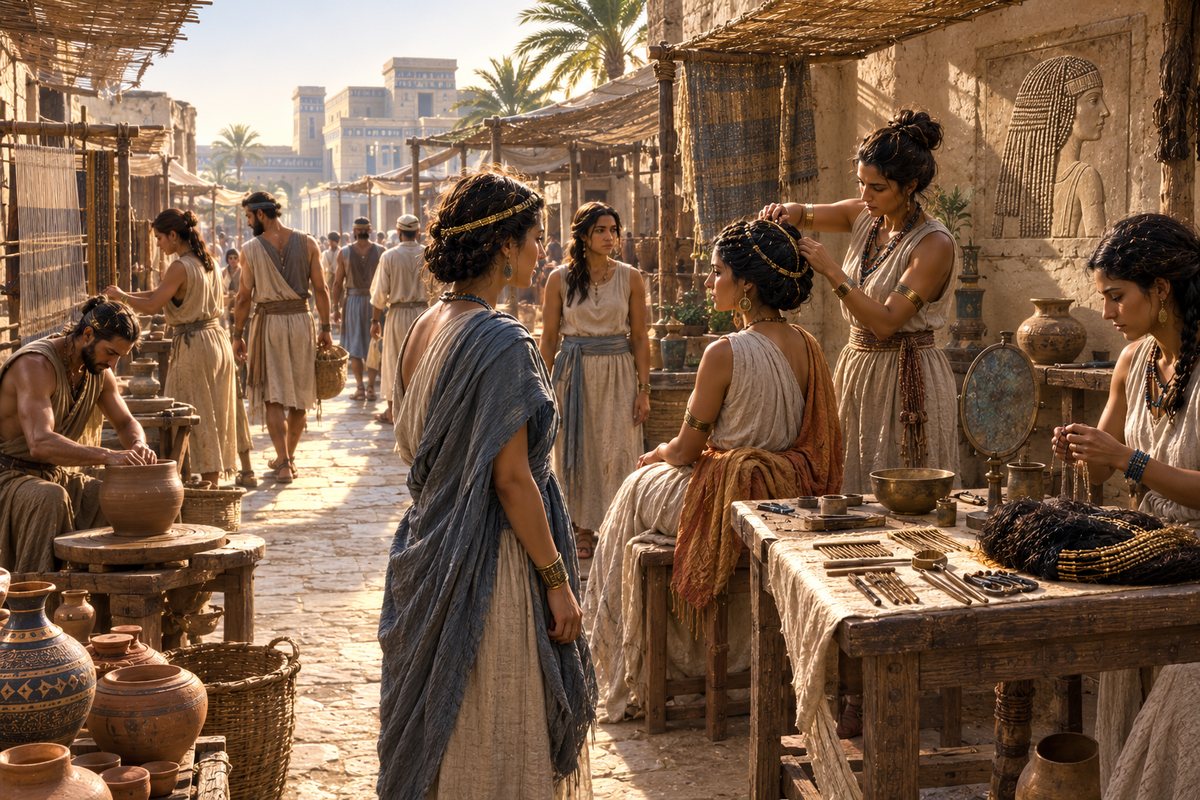
Next in the History of Hairdressing: The Earliest Evidence of Hair Styling in Human Art
With the emergence of specialized grooming, the prehistoric foundation of hairdressing is complete.
The story can now move into societies where images, surviving objects, written records and increasingly detailed archaeological evidence allow us to examine hair care with much greater precision.
From this point forward, the history of hairdressing begins to reveal not only techniques and tools, but recognizable specialists, social roles, beauty practices and traditions preserved by the world’s earliest civilizations.
More from History for Hairdressers
 Chapter 1Before the Hairdresser: The Prehistoric Origins of Hair CarePrehistory & OriginsLong before salons, scissors and professional hairdressers, humans were already managing and transforming th...Read chapter →
 Chapter 2The First Haircut: How Prehistoric Humans Cut Their HairPrehistory & OriginsThousands of years before scissors and metal razors, humans already possessed edges sharp enough to cut hair...Read chapter →
 Chapter 3The First Hair Tools: Stone, Flint, Shell and BonePrehistory & OriginsDiscover the earliest materials prehistoric humans could use for hair care, from sharp flint and stone to sh...Read chapter →
 Chapter 4The Origins of Combs: Humanity’s First Hair-Care ToolPrehistory & OriginsDiscover the origins of combs, from prehistoric toothed tools to ancient bone and ivory combs that reveal th...Read chapter →
 Chapter 5The Origins of Shaving: Before the Metal RazorPrehistory & OriginsExplore the origins of shaving and how sharp stone and flint may have allowed prehistoric humans to remove h...Read chapter →
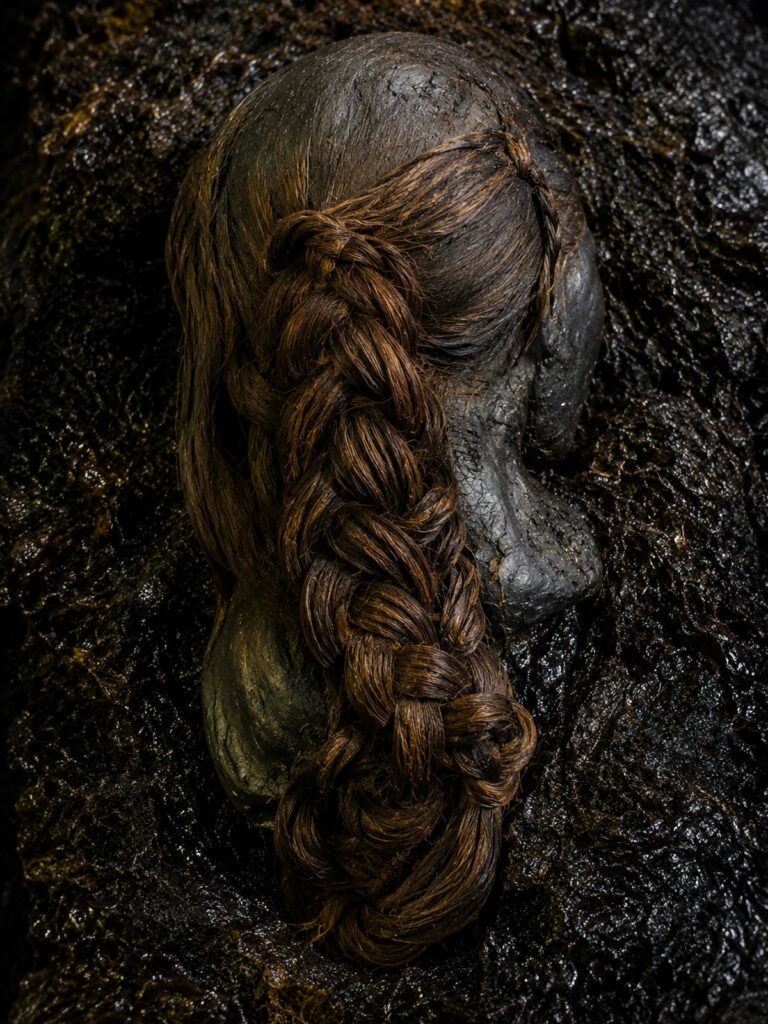 Chapter 6Hair and Human Identity in Prehistoric SocietyPrehistory & OriginsExplore prehistoric hair identity and how hairstyles, grooming and hair representation may have expressed in...Read chapter →
 Chapter 7The Ancient Origins of BraidingPrehistory & OriginsExplore the origins of braiding, from possible Paleolithic representations of complex hairstyles to preserve...Read chapter →
 Chapter 8Hair, Ritual and Spiritual Meaning Before Written HistoryPrehistory & OriginsExplore prehistoric hair rituals and archaeological evidence for cutting, preserving and depositing hair, wh...Read chapter →
 Chapter 9Decorating the Hair: The First Hair OrnamentsPrehistory & OriginsDiscover the first hair ornaments and how prehistoric humans used shells, beads, bone and other materials to...Read chapter →
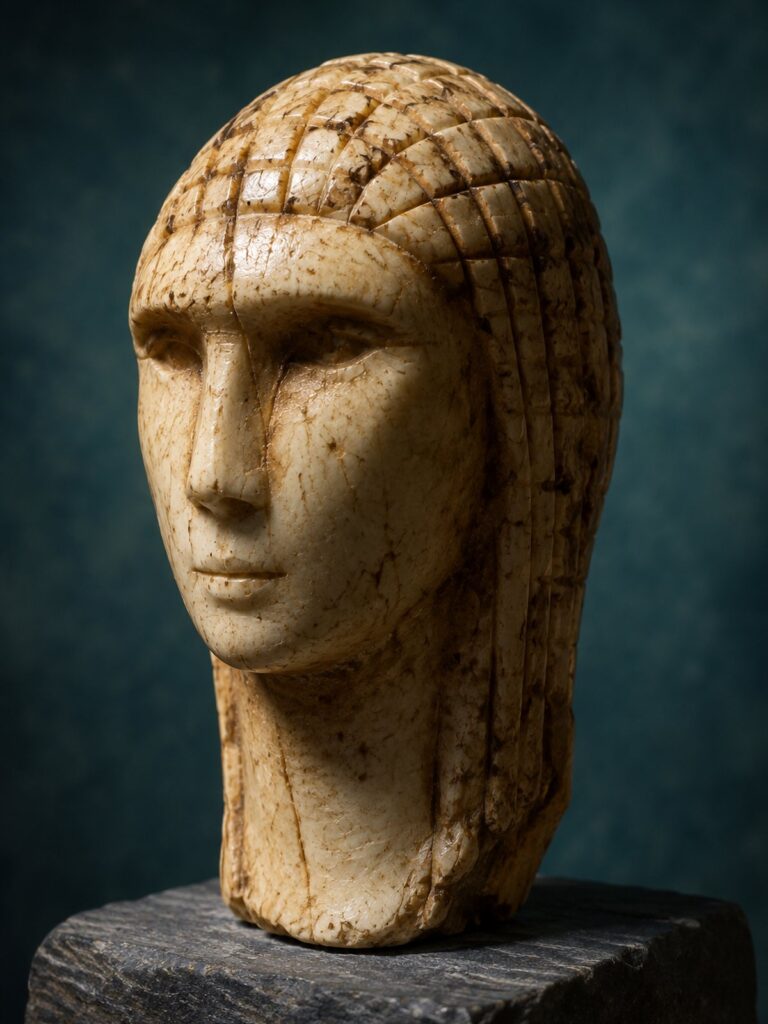 Chapter 10Prehistoric Hairstyles: What Archaeology Can Actually Tell UsPrehistory & OriginsDiscover what archaeology can really tell us about prehistoric hairstyles, from rare preserved hair and anci...Read chapter →
 Chapter 11From Grooming to Beauty: When Hair Became More Than a NecessityPrehistory & OriginsDiscover how prehistoric hair care evolved beyond practical grooming as hair, ornaments and personal appeara...Read chapter →