Prehistoric Hairstyles: What Archaeology Can Actually Tell Us

History of Hairdressing · Prehistory & Origins · Chapter 10
Trying to reconstruct prehistoric hairstyles presents a problem unlike almost any other part of the history of hairdressing.
Stone tools can survive for hundreds of thousands of years. Shells, bones, teeth and ivory ornaments can remain buried long after the people who made them have disappeared. Human skeletons may preserve evidence about age, health and physical life.
Hair is different.
Under ordinary archaeological conditions, hair decomposes. The cords that may have tied it, the fibres used to bind it and many of the materials involved in everyday grooming can disappear as well. A hairstyle that may have taken hours to create can therefore leave almost no direct trace.
Yet prehistoric people certainly had hair, and there is strong reason to believe that they did much more with it than simply allow it to grow.
Archaeology gives us several different kinds of evidence. Tools show that cutting and grooming were technically possible. Personal ornaments demonstrate an increasing interest in appearance. Figurines and other prehistoric images sometimes show patterned, long or carefully arranged forms around the head. Rare examples of preserved hair from later prehistory reveal sophisticated treatment directly.
None of these sources provides a complete prehistoric hairstyle catalogue.
Together, however, they allow us to ask a better question.
Instead of imagining what prehistoric hairstyles should have looked like, what can archaeology actually tell us?
The Greatest Problem: Hair Usually Disappears
The first limitation is preservation.
Hair is made primarily of keratin and can survive under exceptional environmental conditions, but most archaeological sites do not provide those conditions. Moisture, microorganisms, soil chemistry, temperature and physical disturbance can eventually destroy it.
This creates a major imbalance in the archaeological record.
A stone cutting edge used near the body may survive. The hair it potentially cut may not.
A perforated shell placed around the head may survive. The hair, cord or head covering that originally supported it may disappear.
A burial may preserve a skull and ornaments but leave no trace of the hairstyle that once surrounded them.
The absence of hair therefore does not mean the absence of hairstyling.
It means that prehistoric hairdressing has to be reconstructed indirectly.
This is also why confident images of a universal “Stone Age hairstyle” should be treated cautiously. Prehistory covers an enormous span of time, geography and human cultural diversity. There is no reason to expect people living in different environments and separated by thousands of years to have arranged their hair in exactly the same way.
Prehistoric Hair Was Not Necessarily Wild and Unmanaged
Popular culture has created one of the most persistent stereotypes about prehistoric appearance.
The imaginary prehistoric person is often shown with long, tangled and uncontrolled hair.
Archaeology does not justify that assumption.
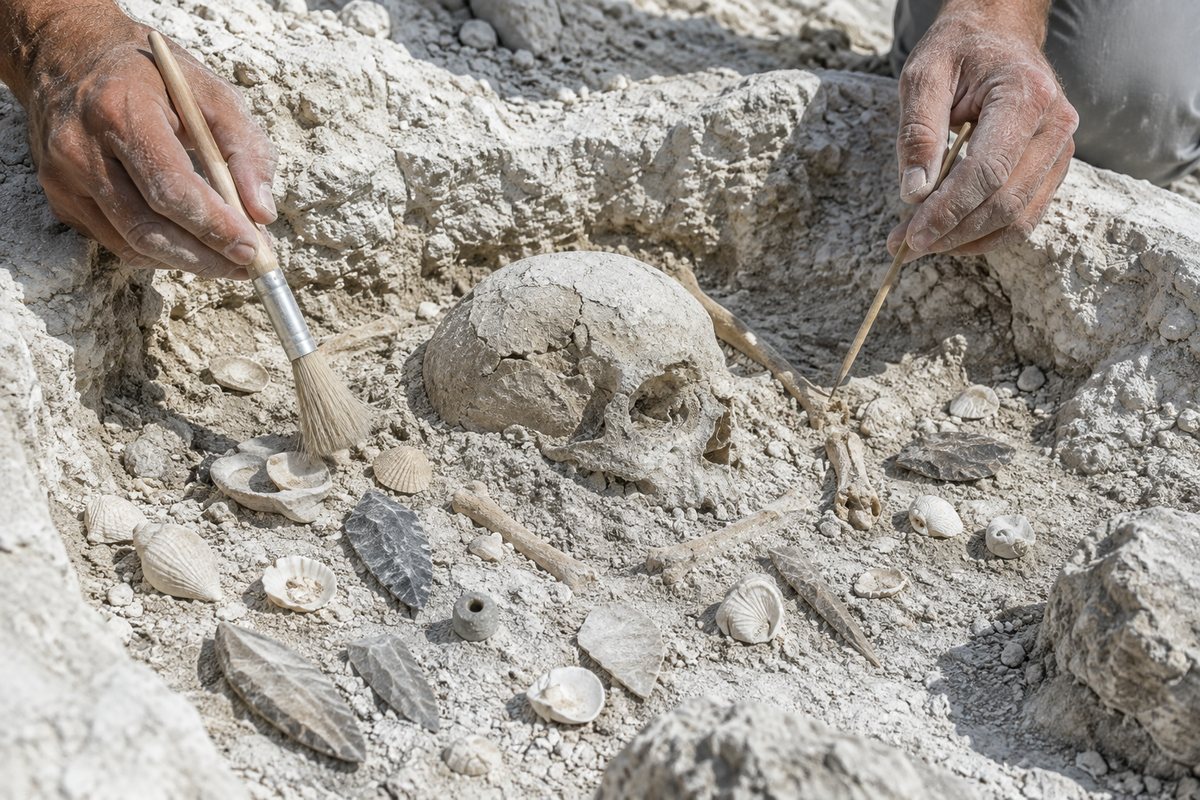
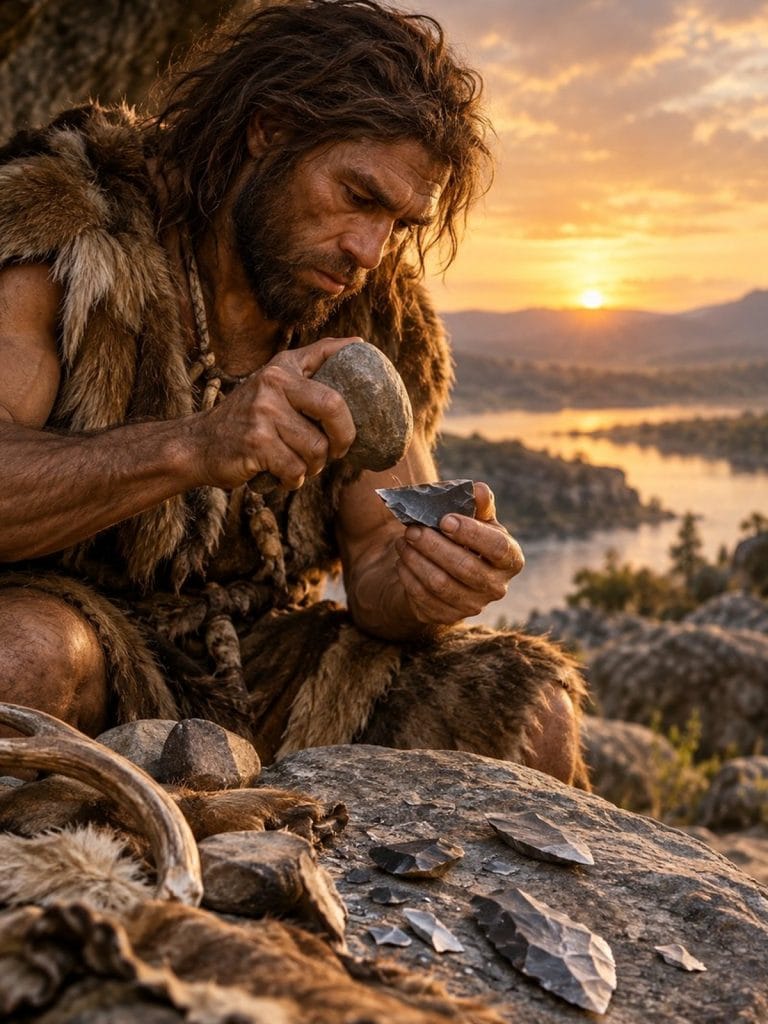
Earlier articles in the History of Hairdressing series have already shown that prehistoric humans possessed materials capable of cutting, scraping and grooming. Sharp stone flakes and blades could perform extremely precise tasks. Bone and other materials could be shaped into useful implements.
The important point is not that every such object was a hairdressing tool. Archaeologists usually cannot determine that.
The point is technological capability.
People capable of processing animal hides, working fibres, carving bone, manufacturing ornaments and producing complex tools were certainly capable of cutting and manipulating human hair.
Basic hair maintenance requires surprisingly little specialized equipment.
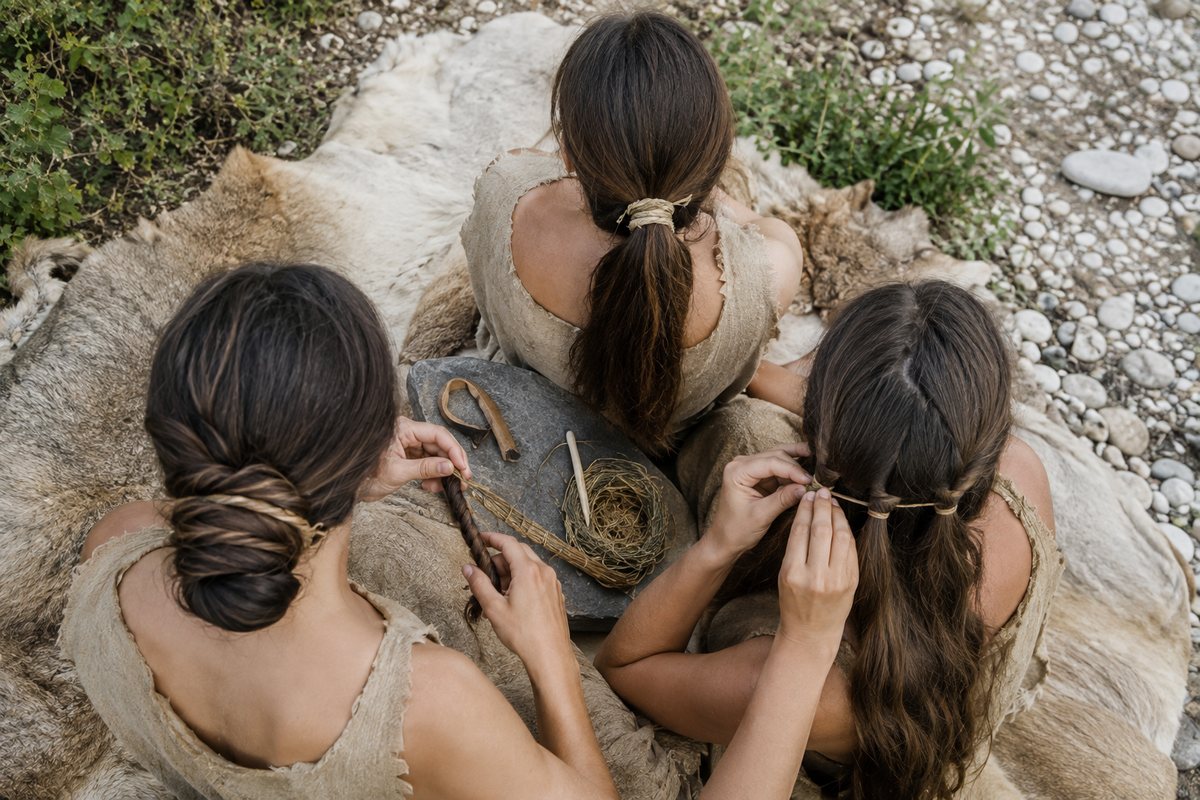
Hair can be shortened with a sharp edge. It can be separated with the fingers. It can be twisted. It can be tied with fibre or leather. Long hair can be gathered away from the face. Sections can be braided without any metal tool at all.
Prehistoric hair should therefore not automatically be imagined as neglected hair.
Tools Tell Us What Was Possible, Not the Exact Hairstyle
Archaeological tools are essential evidence, but they have limits.
A sharp flint blade may demonstrate that fine cutting was possible. It cannot tell us whether a particular person had shoulder-length hair, a shaved scalp or carefully trimmed sections.
A bone implement might have participated in grooming, textile work, leather production or another activity entirely.
This distinction between possibility and proof is fundamental.
Archaeology often reconstructs behaviour by combining several categories of evidence rather than relying on one object.
When we find sophisticated cutting technology, manufactured fibres, personal ornaments and artistic representations of carefully treated heads within prehistoric societies, the broader picture becomes increasingly difficult to reconcile with the idea that appearance was irrelevant.
But we still cannot place a stone blade beside a specific hairstyle and declare that one created the other.
Tools reveal the technological world in which prehistoric hairstyling could exist.
They rarely preserve the finished result.
Prehistoric Figurines Offer a Different Kind of Evidence
Some of the most fascinating clues come not from preserved hair but from prehistoric representations of people.
Upper Palaeolithic figurines are especially important.
These small sculptures were created by people who understood the human body and deliberately chose which features to represent, simplify, exaggerate or omit.
Hair and the head are treated very differently from one figurine to another.
Some heads contain almost no detail.
Others show carefully carved patterns.
That variation is important because it demonstrates that prehistoric artists sometimes considered the appearance of the head significant enough to represent deliberately.
The difficulty begins when modern observers try to decide what those patterns mean.
A carved line might represent hair.
It might represent a braid.
It might represent a woven cap.
It might represent a net or another type of head covering.
After more than twenty thousand years, the difference is not always recoverable.
Prehistoric art therefore gives us visual evidence, but not necessarily a literal portrait.
The Venus of Willendorf: Hair or Headwear?
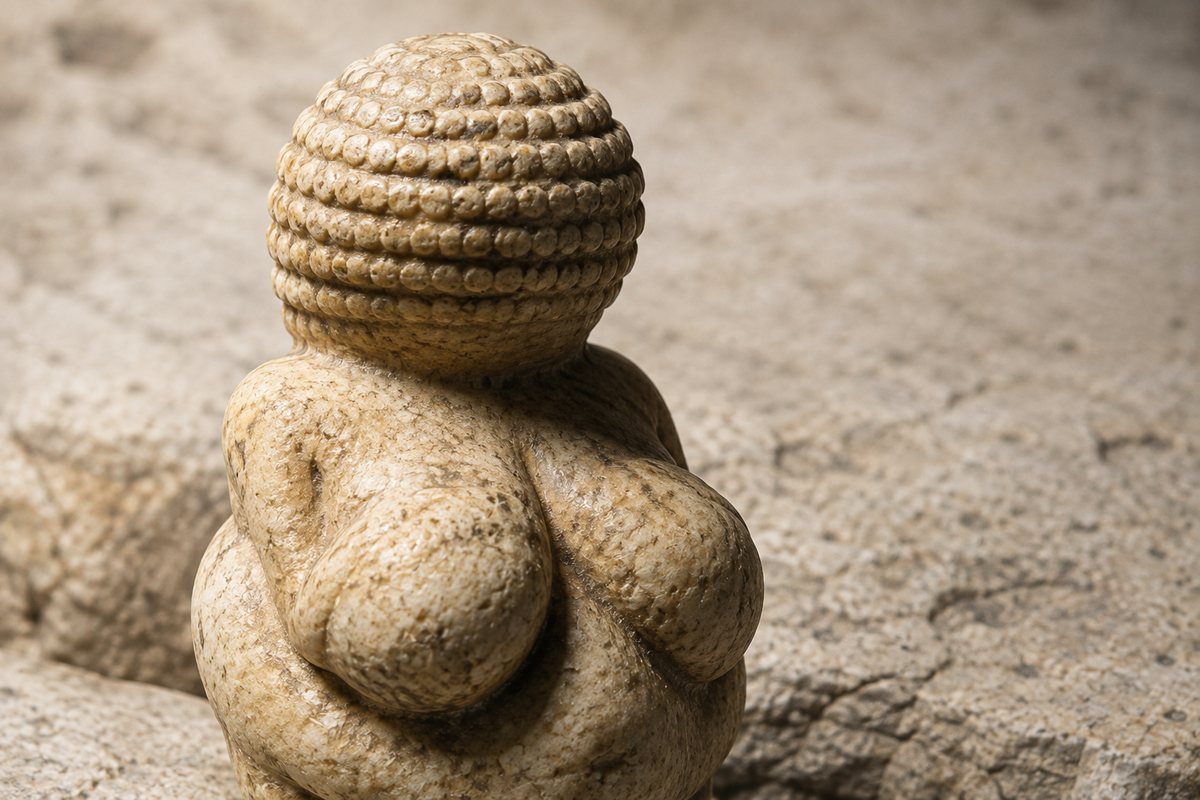
Few prehistoric objects illustrate this problem better than the famous figurine from Willendorf in Austria.
Created roughly 30,000 years ago, the small limestone figure has one of the most recognizable heads in prehistoric art.
Instead of visible facial features, the head is covered by a carefully organized series of curved horizontal bands.
What are they?
There is no universally accepted answer.
The pattern has been interpreted as an elaborate hairstyle, braided or arranged hair, a woven or fibre cap, and other forms of head covering.
This uncertainty is extremely valuable for the history of hairdressing because it prevents us from turning an interpretation into a fact.
The Willendorf figure proves that the artist deliberately created a complex patterned surface around the head.
It does not prove exactly what that surface represents.
If it depicts hair, it would provide striking evidence of sophisticated Palaeolithic hairstyling.
If it represents a cap or other covering, it still demonstrates that the appearance of the head could be carefully constructed.
Either interpretation challenges the stereotype of prehistoric appearance as visually simple.
The Venus of Brassempouy and the Problem of Interpretation
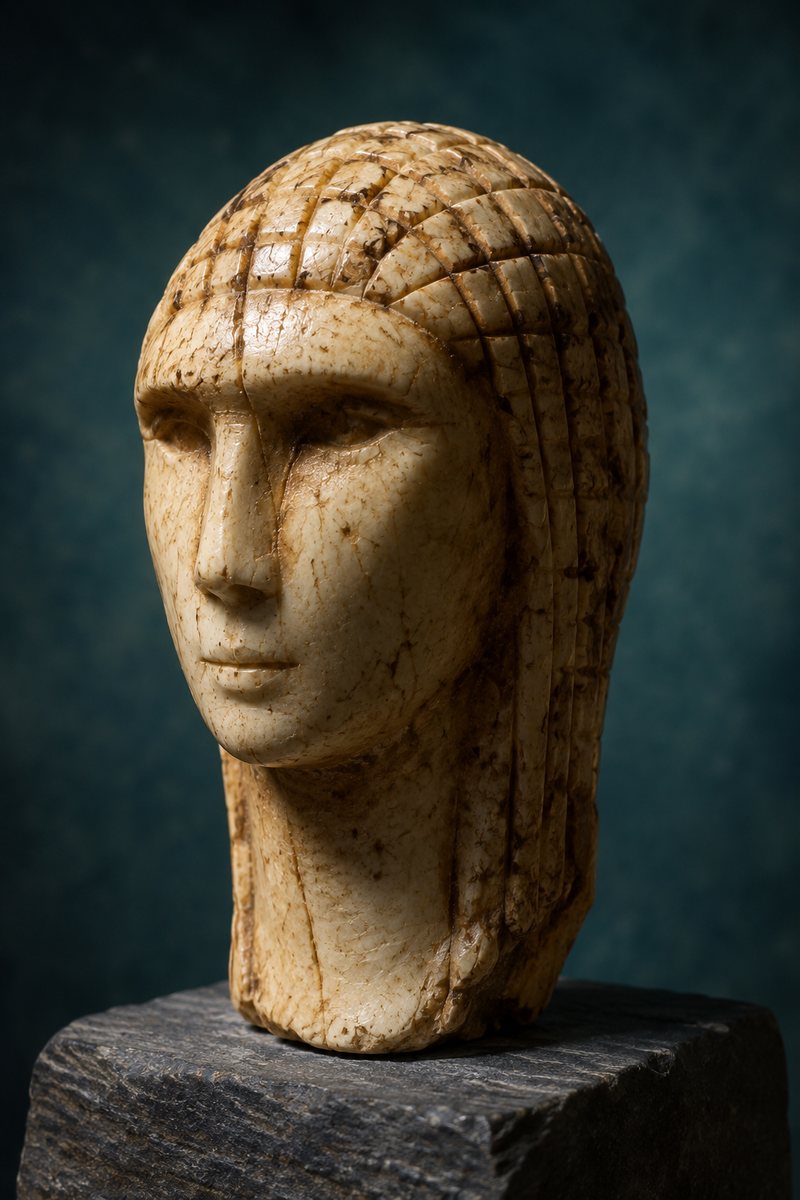
Another famous example comes from Brassempouy in France.
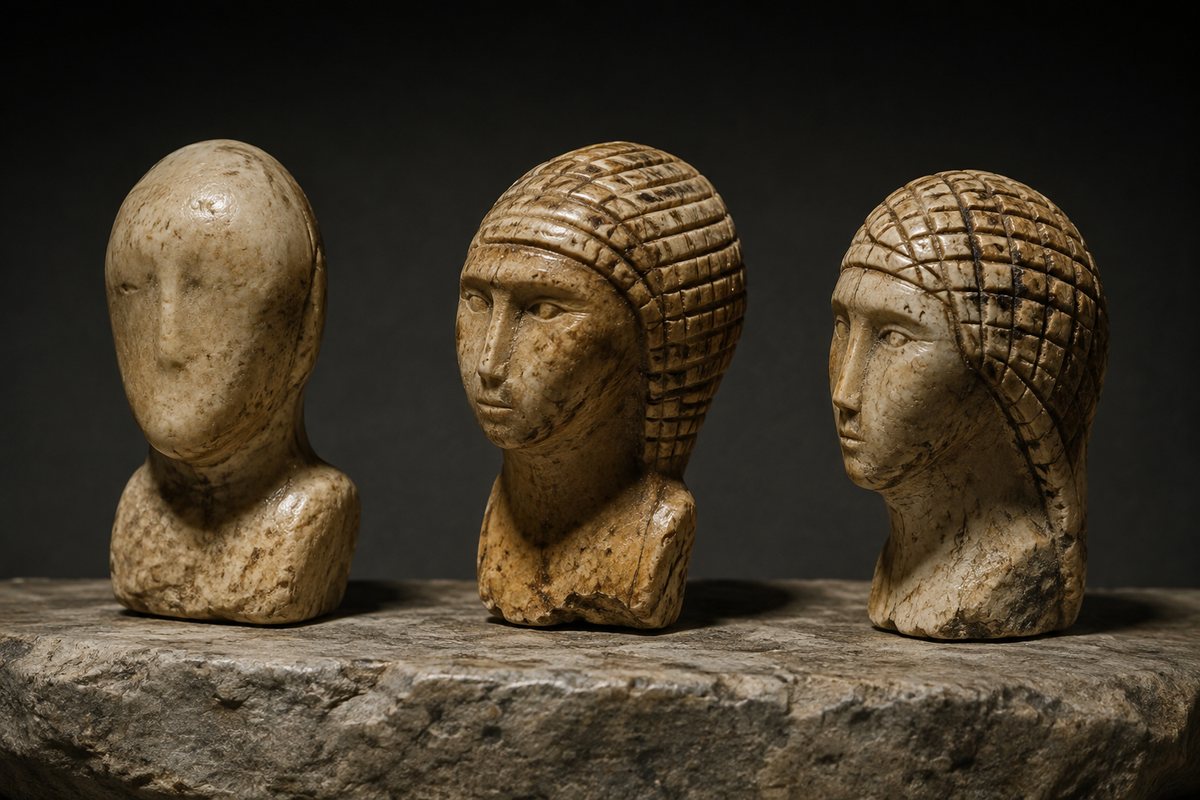
The small ivory head, often known as the Lady of Brassempouy, is remarkable because recognizable facial features are represented with unusual clarity for Upper Palaeolithic art.
Across the upper part of the head is a geometric grid of incised lines.
Once again, the interpretation is uncertain.
The pattern has been described as hair, braided or arranged hair, a hood, a net or another form of head covering.
Modern viewers can easily see a hairstyle because the pattern resembles arrangements familiar from much later periods.
But resemblance is not proof.
The safest interpretation is that the object demonstrates deliberate patterned treatment of the head in Palaeolithic representation.
Whether the original artist intended us to see natural hair, styled hair or something worn over it remains unresolved.
This distinction is not a minor archaeological technicality.
It is one of the central lessons of reconstructing prehistoric hairstyles.
We have images.
We do not have their captions.
Long Hair Clearly Existed
Although exact hairstyles remain difficult to identify, one basic fact is much easier to establish.
Humans can grow long scalp hair.
Unlike most body hair, human scalp hair can remain in its growth phase for years. Long hair therefore existed as a biological possibility long before written history.
Prehistoric art also contains human representations that have been interpreted as showing substantial masses or lengths of hair.
That creates practical consequences.
Long hair moves around the face and body. It can interfere with activities. It can also be gathered, tied, twisted and braided.
People who possessed fibres, cords, strips of hide and other flexible materials had simple technologies available for controlling it.
We cannot know how frequently they did so.
But long hair created both a practical problem and a creative opportunity.
Once hair could be gathered, it could also be deliberately arranged.
Braiding Was Technologically Possible Long Before Written History
Braiding deserves particular caution because modern claims about the “first braid in history” often go far beyond what archaeological evidence can prove.
The basic technology of braiding, however, is unquestionably ancient.
Braiding is not exclusively a hair technique. It is a structural method of interlacing flexible strands.
Prehistoric humans worked with plant fibres, cords and other flexible materials. Once people understood how strands could be divided and interlaced, the same principle could be applied to hair without requiring specialized equipment.
Some Palaeolithic figurines have been interpreted as showing braided or plaited hair.
But the interpretation is not always secure because the same carved patterns can resemble nets, caps or woven coverings.
The correct conclusion is therefore not that archaeology has preserved a complete catalogue of Ice Age braids.
It is that prehistoric humans possessed both the hair and the technical knowledge required to braid it.
The exact styles remain another question.
Hair Could Be Tied, Twisted and Gathered
Braiding is only one possible method of controlling long hair.
Much simpler arrangements require almost no technology.
Hair can be pulled backward and secured.
It can be gathered into one section.
It can be divided into several sections.
A length can be twisted.
Hair can be wrapped around itself.
A cord can hold it against the head or neck.
A band can keep shorter sections away from the face.
These possibilities are so technologically simple that their absence from the archaeological record should not be surprising.
The materials most likely to hold such hairstyles, including plant fibres, sinew, leather strips and textile bands, are precisely the kinds of materials that often disappear.
This gives us an important principle for understanding prehistoric hairstyles:
The simplest hairstyles may be among the least archaeologically visible.
A spectacular ivory ornament has a good chance of surviving.
A plain fibre tie holding someone’s hair for everyday work may leave nothing behind.
Hair Ornaments Give Us Indirect Evidence of Hairstyling
The first hair ornaments discussed in the previous article add another layer of evidence.
Shells, teeth, bone, ivory and beads have been discovered in prehistoric contexts, sometimes positioned around the skull.
Sites such as Sunghir provide strong evidence that the head itself could become an elaborate area of display.
Later Natufian burials provide even clearer examples of decorated headwear.
But an ornament around the head does not automatically reveal the hair underneath it.
A bead could have been attached directly to hair.
It could have been incorporated into a braid.
It could have been sewn onto a band.
It could have decorated a cap, hood or net.
This uncertainty is precisely why ornaments are valuable.
They demonstrate that prehistoric people were thinking about the appearance of the head even when the hairstyle itself has disappeared.
Hair and ornament probably cannot always be separated into the modern categories we use today.
The complete visual effect may have included hair, bindings, coverings and decorative objects working together.
Headwear Can Hide the Hairstyle We Are Trying to Find
There is another complication.
Some objects that appear to show hairstyles may actually show headwear.
This problem occurs repeatedly in prehistoric art.
A patterned surface over the head can resemble braids or tightly arranged curls. The same pattern can also resemble woven fibre.
Without surviving organic material or additional contextual evidence, deciding between the two can be impossible.
That does not make the image useless.
It changes the question.
Instead of asking only, “What hairstyle is this?” we can ask, “How was the prehistoric head visually constructed?”
That broader approach is often more productive.
Hair may have been only one component.
Caps, nets, bands, cords, beads, shells and other materials could alter the outline and texture of the head.
Prehistoric head styling may therefore have been considerably more sophisticated than the surviving evidence initially suggests.
Later Prehistory Shows What Exceptional Preservation Can Reveal
As we move closer to historical periods, rare preservation conditions begin to reveal what ordinary archaeological sites usually conceal.
Hair has survived in some naturally preserved bodies and burials, particularly in environments that inhibit normal decomposition.
Later prehistoric European bog bodies are especially famous examples.
Here, hair can survive well enough to show cutting, arrangement and sometimes complex treatment.
These finds belong much later than the Palaeolithic world of Willendorf or Brassempouy, so they cannot simply be projected backward thousands of years.
Their importance is methodological.
They show how misleading the normal archaeological record can be.
Where preservation is exceptional, sophisticated hair treatment becomes visible.
Where preservation is poor, the same kinds of organic practices could disappear completely.
The difference between the two records may therefore reflect preservation as much as behaviour.
There Was Probably No Single “Prehistoric Hairstyle”
The phrase “prehistoric hairstyle” can itself create a false impression.
Prehistory is not one culture.
It includes enormous geographical regions and an extraordinary span of time.
People lived on coasts, grasslands, forests, mountains and cold steppe environments. They moved, exchanged materials, developed different technologies and created different visual traditions.
Hair also varies naturally between individuals and populations in texture, density, curl pattern and growth.
There is therefore no archaeological reason to imagine one universal hairstyle worn by prehistoric humans.
Some people may have kept hair short.
Others may have allowed it to grow long.
Some may have tied it for practical reasons.
Others may have braided, twisted or decorated it.
Hair arrangements could also have changed with age, activity, season, personal preference or social context.
We should expect diversity even when archaeology cannot preserve all of it.
What Archaeology Can Actually Tell Us
After removing speculation, what remains?
Quite a lot.
We know that prehistoric humans possessed the technological ability to cut and manipulate hair.
We know that long scalp hair existed and could be tied, divided, twisted or braided using extremely simple techniques.
We know that prehistoric people manufactured sophisticated personal ornaments and sometimes concentrated them around the head.
We know that Upper Palaeolithic artists occasionally represented heads with complex patterned surfaces that may depict hairstyles or head coverings.
We know that later exceptional preservation demonstrates that prehistoric and early historic communities could create carefully treated hairstyles that would normally disappear from the archaeological record.
What we usually cannot know is equally important.
We cannot assign every patterned figurine a specific modern hairstyle.
We cannot assume that every bead beside a skull was tied directly into hair.
We cannot reconstruct universal grooming rules from isolated finds.
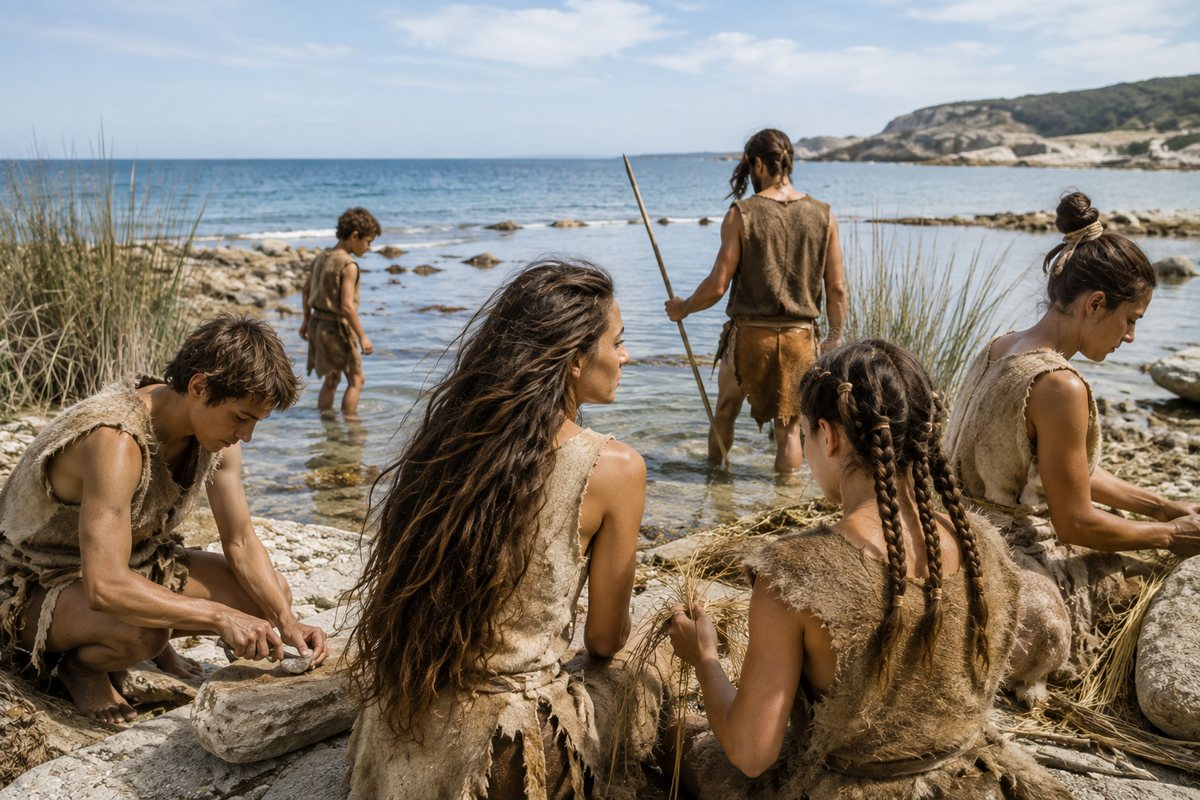
And we cannot treat modern artistic reconstructions as archaeological photographs.
The history of prehistoric hair is therefore built from probabilities, comparisons and carefully defined limits.
That does not make it less interesting.
It makes it more accurate.
Prehistoric Hairdressing Exists in the Space Between Evidence and Absence
Hair is one of the most personal and visually powerful parts of human appearance, yet it is also one of the least likely to survive deep time.
That contradiction defines the earliest history of hairdressing.
Stone survives.
Bone survives.
Shell survives.
Ivory survives.
Hair usually does not.
Yet around that missing material we find tools capable of cutting it, fibres capable of binding it, ornaments capable of decorating it and images that may preserve echoes of how it was arranged.
The result is not a complete picture.
It is something more fragmented and, in many ways, more fascinating.
Prehistoric hairstyles were almost certainly more diverse than archaeology can show us today. Some may have been simple and practical. Others may have involved considerable skill. Some may have combined hair with ornaments, bands, nets or coverings in ways that no surviving object allows us to reconstruct completely.
The responsible approach is not to fill those gaps with fantasy.
It is to recognize what the surviving evidence makes possible.
Prehistoric humans did not need metal scissors, modern combs or mirrors to begin manipulating hair.
They needed hair, hands, cutting edges, flexible materials and an interest in appearance.
All of those existed long before written history.
Next in the History of Hairdressing: From Grooming to Beauty, When Hair Became More Than a Necessity
Once archaeology shows us that prehistoric people could cut, arrange, bind and decorate their hair, another question becomes unavoidable.
When did grooming begin to move beyond individual improvisation toward repeated techniques and recognizable practices?
The next stage of the History of Hairdressing follows that development as hair care becomes increasingly structured and the foundations of specialized grooming begin to emerge.
More from History for Hairdressers
 Chapter 1Before the Hairdresser: The Prehistoric Origins of Hair CarePrehistory & OriginsLong before salons, scissors and professional hairdressers, humans were already managing and transforming th...Read chapter →
 Chapter 2The First Haircut: How Prehistoric Humans Cut Their HairPrehistory & OriginsThousands of years before scissors and metal razors, humans already possessed edges sharp enough to cut hair...Read chapter →
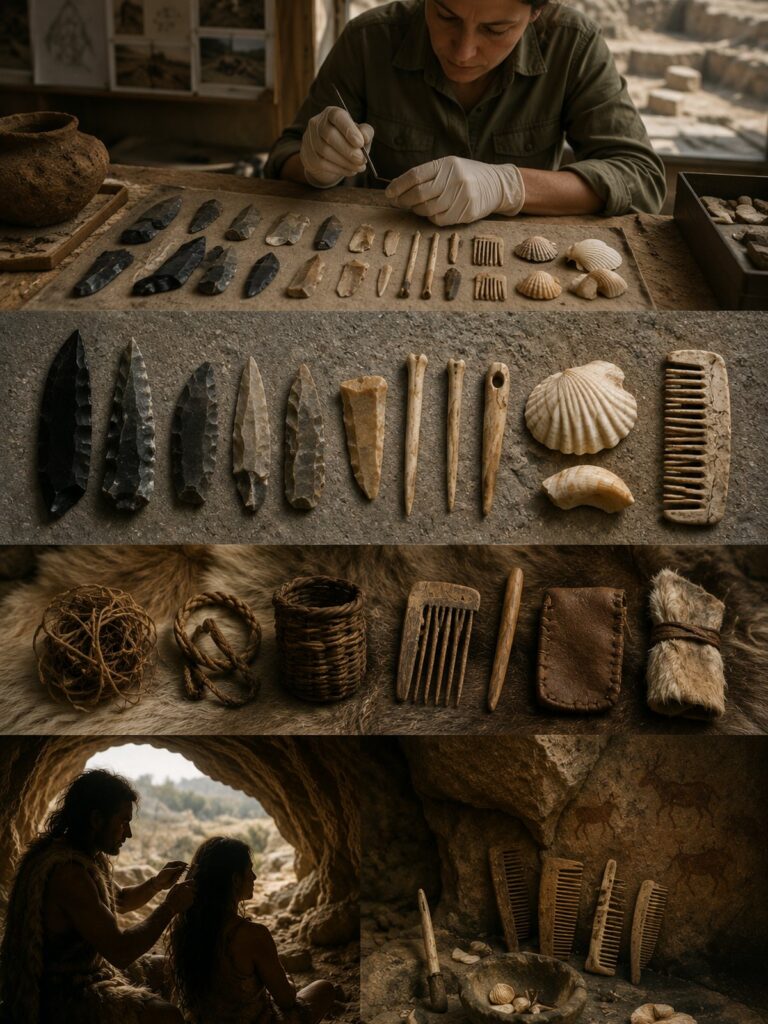 Chapter 3The First Hair Tools: Stone, Flint, Shell and BonePrehistory & OriginsDiscover the earliest materials prehistoric humans could use for hair care, from sharp flint and stone to sh...Read chapter →
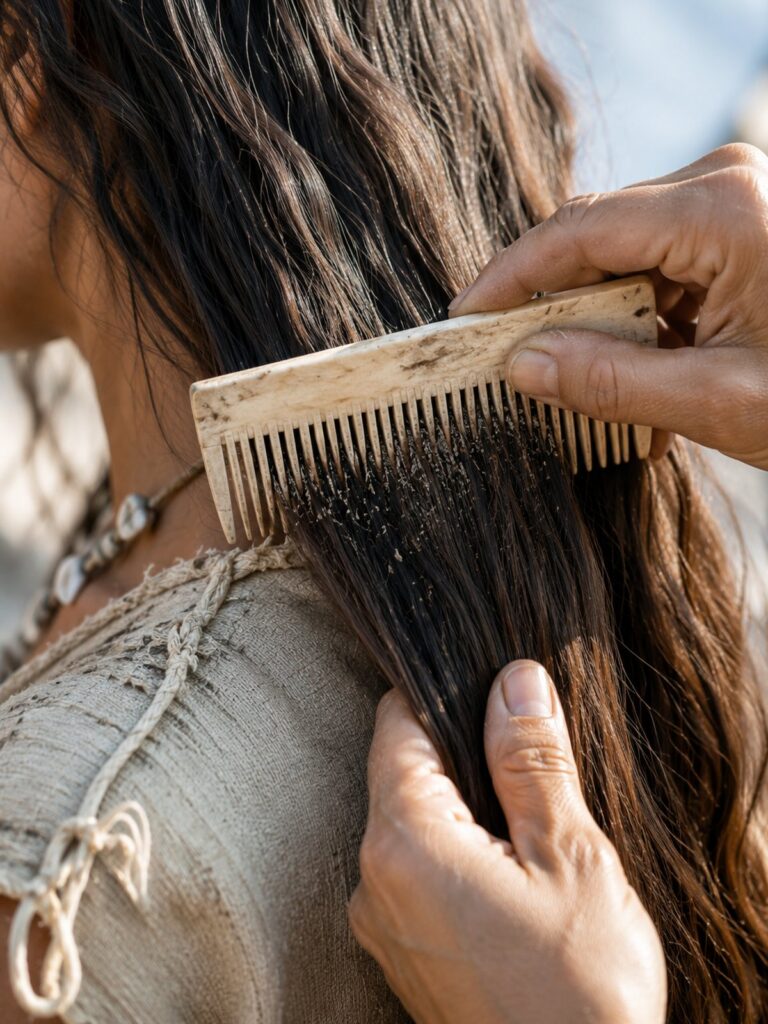 Chapter 4The Origins of Combs: Humanity’s First Hair-Care ToolPrehistory & OriginsDiscover the origins of combs, from prehistoric toothed tools to ancient bone and ivory combs that reveal th...Read chapter →
 Chapter 5The Origins of Shaving: Before the Metal RazorPrehistory & OriginsExplore the origins of shaving and how sharp stone and flint may have allowed prehistoric humans to remove h...Read chapter →
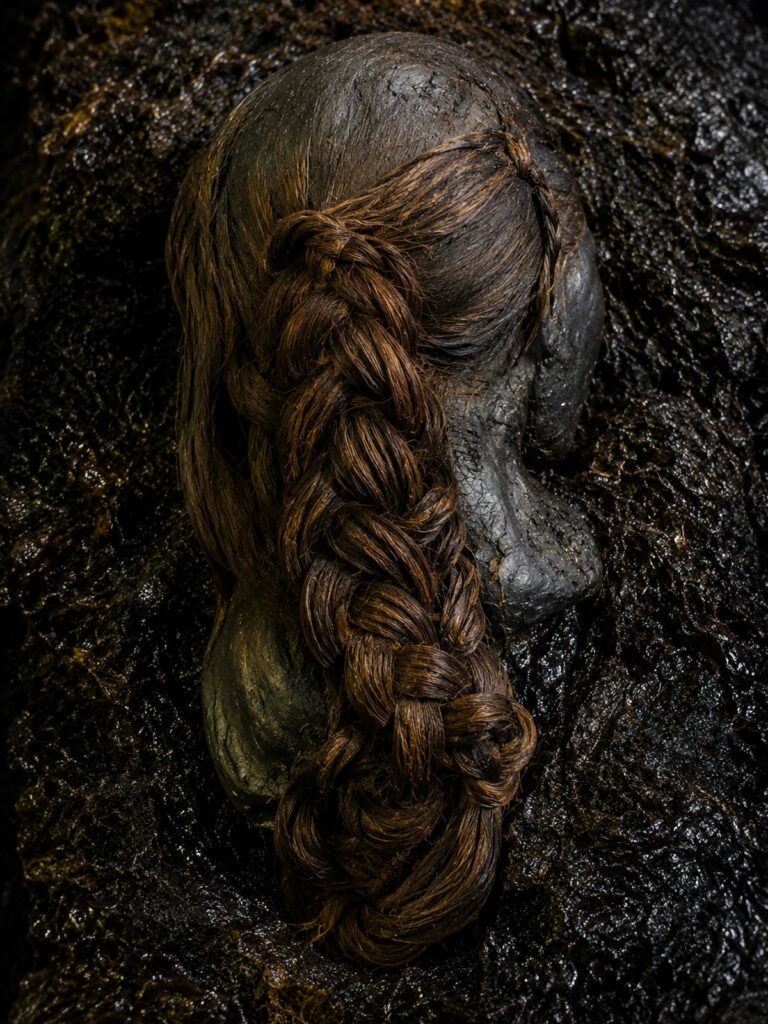 Chapter 6Hair and Human Identity in Prehistoric SocietyPrehistory & OriginsExplore prehistoric hair identity and how hairstyles, grooming and hair representation may have expressed in...Read chapter →
 Chapter 7The Ancient Origins of BraidingPrehistory & OriginsExplore the origins of braiding, from possible Paleolithic representations of complex hairstyles to preserve...Read chapter →
 Chapter 8Hair, Ritual and Spiritual Meaning Before Written HistoryPrehistory & OriginsExplore prehistoric hair rituals and archaeological evidence for cutting, preserving and depositing hair, wh...Read chapter →
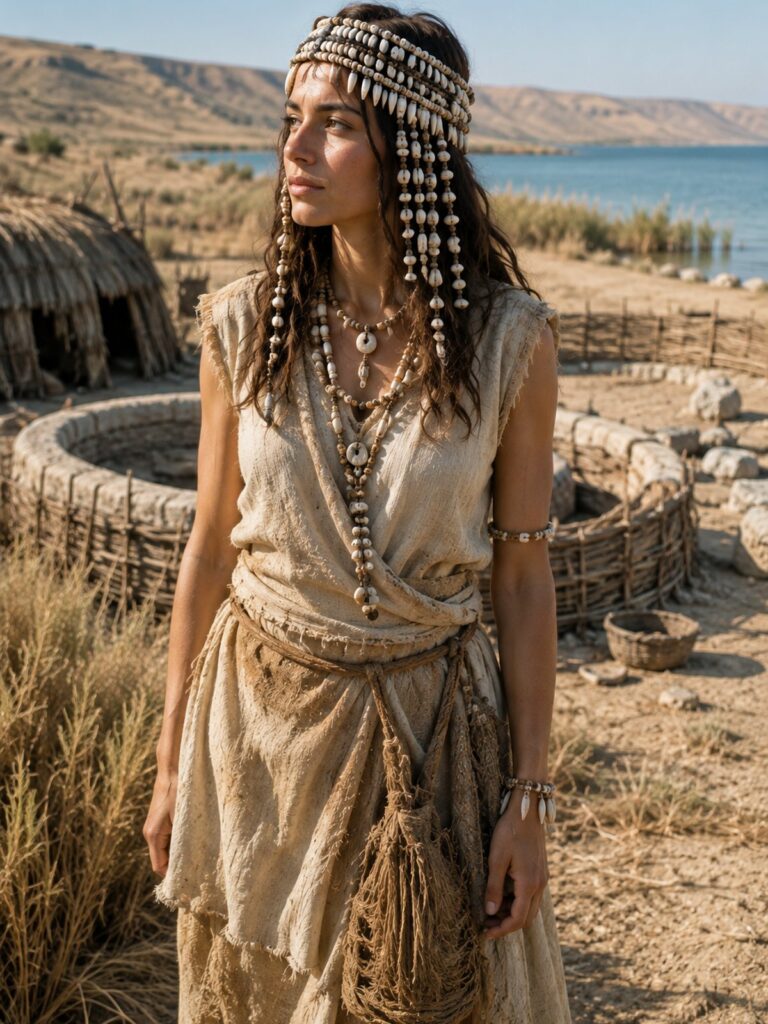 Chapter 9Decorating the Hair: The First Hair OrnamentsPrehistory & OriginsDiscover the first hair ornaments and how prehistoric humans used shells, beads, bone and other materials to...Read chapter →